Indra , Lakshmi, Shachi, Brihaspati
Indra:
Indra is the king of the devas and Svarga in Hinduism. He is associated with the sky, lightning, weather, thunder, storms, rains, river flows, and war.Indra is the most referred deity in the Rigveda.He is celebrated for his powers based on his status as a god of order,[4] and as the one who killed the great evil, an asura named Vritra, who obstructed human prosperity and happiness. Indra destroys Vritra and his "deceiving forces", and thereby brings rain and sunshine as the saviour of mankind.
Indra's significance diminishes in the post-Vedic Indian literature, but he still plays an important role in various mythological events. He is depicted as a powerful hero, and is known for having sexual relations with Sage Gautama's wife, Ahalya.According to the Vishnu Purana, Indra is the title borne by the king of the gods, changes every Manvantara – a cyclic period of time in Hindu cosmology. Each Manvantara has its own Indra and the Indra of the current Manvantara is called Purandhara.
 Indra is also depicted in Buddhist (Pali: Inda)and Jain mythologies. Indra rules over the much-sought Devas realm of rebirth within the Samsara doctrine of Buddhist traditions. However, like the post-Vedic Hindu texts, Indra is also a subject of ridicule and reduced to a figurehead status in Buddhist texts, shown as a god that suffers rebirth. In Jain traditions, unlike Buddhism and Hinduism, Indra is not the king of gods, but the king of superhumans residing in Svarga-Loka, and very much a part of Jain rebirth cosmology.He is also the one who appears with his consort Indrani to celebrate the auspicious moments in the life of a Jain Tirthankara, an iconography that suggests the king and queen of superhumans residing in Svarga reverentially marking the spiritual journey of a Jain. He is a rough equivalent to Zeus in Greek mythology, or Jupiter in Roman mythology. Indra's powers are similar to other Indo-European deities such as Norse Odin, Perun, Perkūnas, Zalmoxis, Taranis, and Thor, part of the greater Proto-Indo-European mythology.
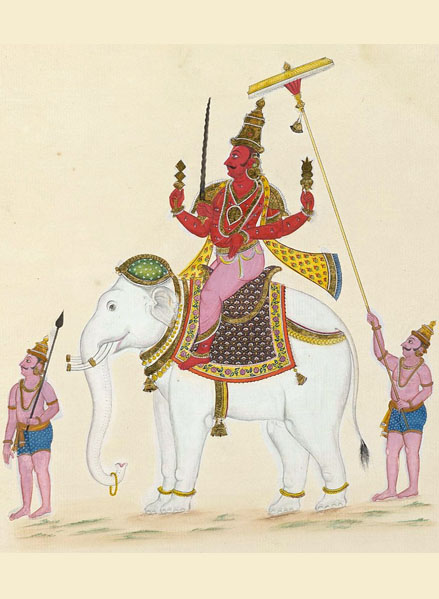
Indra's iconography shows him wielding his Vajra and riding his vahana, Airavata.Indra's abode is in the capital city of Svarga, Amaravati, though he is also associated with Mount Meru (also called Sumeru). Etymology and nomenclature, Indra on his elephant, guarding the entrance of the 1st century BCE Buddhist Cave 19 at Bhaja Caves (Maharashtra). The etymological roots of Indra are unclear, and it has been a contested topic among scholars since the 19th-century, one with many proposals. The significant proposals have been:
Colonial era scholarship proposed that Indra shares etymological roots with Avestan Andra, Old High German *antra giant or Old Church Slavonic jedru strong, but Max Muller critiqued these proposals as untenable. Later scholarship has linked Vedic Indra to Aynar (the Great One) of Circassian, Abaza and Ubykh mythology, and Innara of Hittite mythology.Colarusso suggests a Pontic[b] origin and that both the phonology and the context of Indra in Indian religions is best explained from Indo-Aryan roots and a Circassian etymology . Modern scholarship suggests the name originated at the Bactria–Margiana Archaeological Complex where the Aryans lived before settling in India.
Lakshmi:
Lakshmi (/ˈlʌkʃmi/;[nb] Sanskrit: लक्ष्मी, IAST: Laksmi, sometimes spelled Laxmi, lit. 'she who leads to one's goal') also known as Shri (Sanskrit: श्री, IAST: Sri, lit. 'Noble'), is one of the principal goddesses in Hinduism. She is the goddess of wealth, fortune, power, beauty, fertility and prosperity, and associated with Maya ("Illusion"). Along with Parvati and Saraswati, she forms the Tridevi of Hindu goddesses.
Within the goddess-oriented Shaktism, Lakshmi is venerated as the prosperity aspect of the Mother goddess.Lakshmi is both the consort and the divine energy (shakti) of the Hindu god Vishnu, the Supreme Being of Vaishnavism; she is also the Supreme Goddess in the sect and assists Vishnu to create, protect, and transform the universe. She is an especially prominent figure in Sri Vaishnavism, in which devotion to Lakshmi is deemed to be crucial to reach Vishnu. Whenever Vishnu descended on the earth as an avatar, Lakshmi accompanied him as consort, for example, as Sita and Radha or Rukmini as consorts of Vishnu's avatars Rama and Krishna, respectively. The eight prominent manifestations of Lakshmi, the Ashtalakshmi, symbolise the eight sources of wealth.
Lakshmi is depicted in Indian art as an elegantly dressed, prosperity-showering golden-coloured woman standing or sitting in the padmasana position upon a lotus throne, while holding a lotus in her hand, symbolising fortune, self-knowledge, and spiritual liberation.Her iconography shows her with four hands, which represent the four aspects of human life important to Hindu culture: dharma, kama, artha, and moksha.The Lakshmi Sahasranama of the Skanda Purana, Lakshmi Tantra, Markandeya Purana, Devi Mahatmya, and Vedic scriptures describe Lakshmi as having eight or eighteen hands, and as sitting on Garuda, a lion, or a tiger. According to the Lakshmi Tantra, the goddess Lakshmi, in her ultimate form of Mahasri, has four arms of a golden complexion, and holds a citron, a club, a shield, and a vessel containing amrita. In the Skanda Purana and the Venkatachala Mahatmayam, Sri, or Lakshmi, is praised as the mother of Brahma.