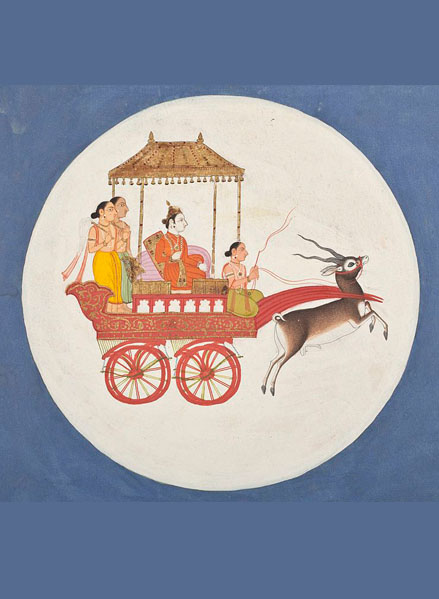
Chandra, Vayu
Chandra:
Chandra (Sanskrit: चन्द्र, romanized: Candra, lit. 'shining' or 'moon'), also known as Soma (Sanskrit: सोम), is the Hindu god of the Moon, and is associated with the night, plants and vegetation. He is one of the Navagraha (nine planets of Hinduism) and Dikpala (guardians of the directions).Etymology and other names The scriptures compare the Moon to a white goose in the blue lake of sky. The word "Chandra" literally means "bright, shining or glittering" and is used for the "Moon" in Sanskrit and other Indian languages. It is also the name of various other figures in Hindu mythology, including an asura and a Suryavamsha king.It is also a common Indian name and surname. Both male and female name variations exist in many South Asian languages that originate from Sanskrit.

 Some of the synonyms of Chandra include Soma (distill), Indu (bright drop), Atrisuta (son of Atri), Shashin or Shachin (marked by hare), Taradhipa (lord of stars) and Nishakara (the night maker), Nakshatrapati (lord of the Nakshatra), Oshadhipati (lord of herbs), Uduraj or Udupati (water lord), Kumudanatha (lord of lotuses) and Udupa (boat).
Soma: Soma is one of the most common other names used for the deity; but the earliest use of the word to refer to the Moon is a subject of scholarly debate. Some scholars state that the word Soma is occasionally used for the Moon in the Vedas, while other scholars suggest that such usage emerged only in the post-Vedic literature.In the Vedas, the word Soma is primarily used for an intoxicating and energizing/healing plant drink and the deity representating it.In post-Vedic Hindu mythology, Soma is used for Chandra, who is associated with the moon and the plant.The Hindu texts state that the Moon is lit and nourished by the Sun, and that it is Moon where the divine nectar of immortality resides. In Puranas, Soma is sometimes also used to refer to Vishnu, Shiva (as Somanatha), Yama and Kubera. In some Indian texts, Soma is the name of an apsara; alternatively it is the name of any medicinal concoction, or rice-water gruel, or heaven and sky, as well as the name of certain places of pilgrimage.
Literature:Possible depiction of the Moon God Chandra in his chariot with wife and attendant, 2nd-1st century BCE, Shunga period, West Bengal.The origin of Soma is traced back to the Hindu Vedic texts, where he is the personification of a drink made from a plant with the same name. Scholars state that the plant had an important role in Vedic civilization and thus, the deity was one of the most important gods of the pantheon. In these Vedic texts, Soma is praised as the lord of plants and forests; the king of rivers and earth; and the father of the gods.
The entire Mandala 9 of the Rigveda is dedicated to Soma, both the plant and the deity. The identification of Soma as a lunar deity in the Vedic texts is a controversial topic among scholars.[9] According to William J. Wilkins, "In later years the name Soma was given to the moon. How and why this change took place is not known; but in the later of the Vedic hymns there is some evidence of the transition.