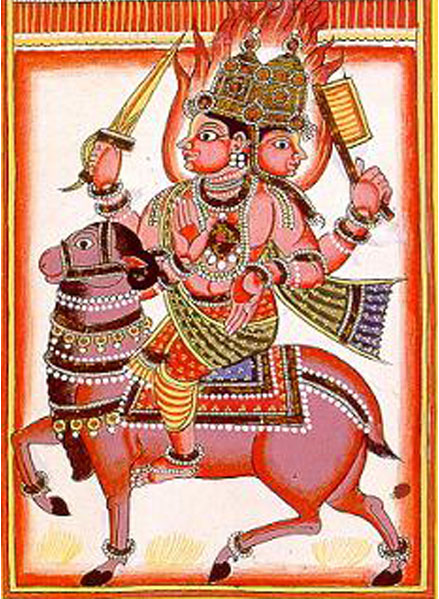
Agni, Mangala,Svaha
Agni, Mangala,Svaha
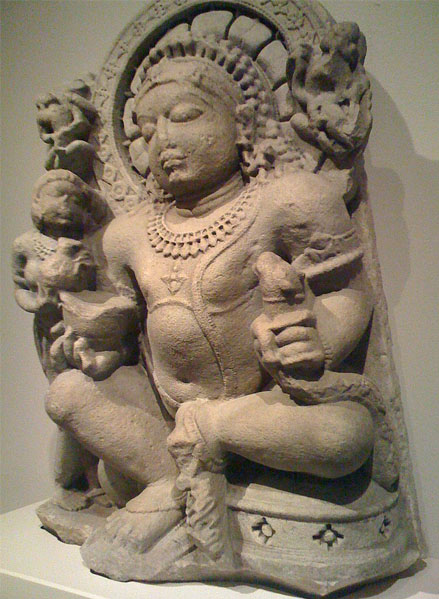
Agni is a Sanskrit word meaning fire and connotes the Vedic fire deity of Hinduism. He is also the guardian deity of the southeast direction and is typically found in southeast corners of Hindu temples. In the classical cosmology of the Indian religions, Agni as fire is one of the five inert impermanent elements (pancabhuta) along with space (akasa), water (ap), air (vayu) and earth (prithvi), the five combining to form the empirically perceived material existence (Prakriti). In Vedic literature, Agni is a major and oft-invoked god along with Indra and Soma.
Agni is considered the mouth of the gods and goddesses and the medium that conveys offerings to them in a homa. He is conceptualized in ancient Hindu texts to exist at three levels, on earth as fire, in the atmosphere as lightning, and in the sky as the sun. This triple presence accords him as the messenger between the deities and human beings in the Vedic scriptures. The relative importance of Agni declined in the post-Vedic era, as he was internalized and his identity evolved to metaphorically represent all transformative energy and knowledge in the Upanishads and later Hindu literature.
Agni remains an integral part of Hindu traditions, such as being the central witness of the rite-of-passage ritual in traditional Hindu weddings called Saptapadi or Agnipradakshinam (seven steps and mutual vows), in the Upanayana ceremony of rite of passage, as well being part of the diya (lamp) in festivals such as Deepavali and Aarti in Puja. Agni (Pali: Aggi) is a term that appears extensively in Buddhist textsand in the literature related to the Senika heresy debate within the Buddhist traditions. In the ancient Jainism thought, Agni (fire) contains soul and fire-bodied beings, additionally appears as Agni-kumara or "fire princes" in its theory of rebirth and a class of reincarnated beings and is discussed in its texts with the equivalent term Tejas.
Mangala is the name for Mars, the red planet, in Hindu texts.Also known as Lohit (meaning: red), he is the celibate god of anger, aggression & war.His origins vary with different mythological texts; in most texts, he is the son of Bhumi, the Earth Goddess and Vishnu, born when he raised her from the depths of water in Varaha avatar.
Svaha
Svaha , also referred to as Manyanti, is the Hindu goddess of sacrifices featured in the Vedas.She is the consort of Agni, and the daughter of either Daksha or Brihaspati, depending on the literary tradition. According to the Brahmavaivarta Purana, she is an aspect of Prakriti (nature), an element without which Agni cannot sustain.Additionally, in Hinduism and Buddhism, the Sanskrit lexical item svaha (romanized Sanskrit transcription; Devanagari: Khmer ,Thai: , Chinese, Japanese: sowaka is a denouement used at the end of a mantra, which is invoked during yajna fire sacrifices and worship.Svaha is chanted to offer oblation to the gods. As a feminine noun, svaha in the Rigveda may also mean oblation (to Agni or Indra). Svaha is also considered to mean an auspicious ending.