
Sri Kalahasthi temple is situated 36kms away from Tirupathi and it is the only shrine for the God of Vayu . This temple was constructed by the Chola King, Rajendra Chola .Vayu is incarnated as Lord Shiva and worshipped as Kalahasteeswara. Goddess Parvathi devi is worshipped here as Gnanaprasunambika.Srikalahasti Temple is located in the town of Srikalahasti, in Tirupati district in the state of Andhra Pradesh,
India.It is one of the most famous Shiva temples in South India, and is said to be the site where Kannappa was ready to offer both his eyes to cover blood flowing from the linga before Shiva stopped him and granted him moksha.Srikalahasti temple, situated 36 km away from Tirupati is famous for its Vayu Lingam (Wind Lingam),one of the Panchabhoota Sthalams, representing wind.
The temple is also regarded as Rahu-Ketu kshetra and Dakshina Kailasam. The inner temple was constructed around 5th century and the outer temple was constructed in the 11th century by the Rajendra Chola I, later Chola kings and the Vijayanagara kings. Shiva in his aspect as Vayu is worshiped as Kalahasteeswara.
According to ancient Tamil sources Sri Kalahasti has been known as the ‘Kailas of the South’ for slightly more than two thousand years and the small river on whose banks it sits, the ‘Ganges of the South.’ Kailas is perhaps India’s most revered spiritual symbol.
It is the abode of Shiva, from whose head, according to legend, the Ganges is said to flow. Shiva, ‘that which is auspicious at all places, times and in all circumstances’ is a symbol of the Self and the Ganges flowing from his head represents the spiritualized or awakened mind.
A mind sourced in Spirit is a river of immeasurable power and life-giving goodness.The claim that Kalahasti is the ‘Kailas of the South’ simply means that the small hill near the temple is to be taken as the spiritual equivalent of the Himalayan Kailas. Likewise, the small river flowing in a northerly direction beside the temple is to be taken as the mighty Ganges.

Even the cardinal directions have assumed symbolic significance in Pauranic culture. Obviously context should be taken into account when divining the meaning of a symbol, but north, for example, is said to be the abode of the Self because from the immortal ‘northern’ position the Self looks out on the ‘southern’ world of time and death. The idiom to “head south’ means to go downhill, to decay.
The God Dakshinamurthy whose name means ‘the one facing south’ and whose idol (murthy) is installed in the Kalahasti Temple, sits in the North and faces south. East often represents the dawning of wisdom, the sun being another common Self symbol. The symbolic use of direction culminates in the idea of building temples at the point on a river where its meandering points it back to its source.
The holiest city in India, Benaras, is built on a stretch of the Ganges that flows northward, the idea being that when the mind turns back toward its source, the God/Self, it realizes its innate divinity. So, the small river on whose banks the Kalahasthi temple is situated is meant to remind us of the Ganges and the wealth of spiritual associations it conjures.

The Vedas posit four ends for which human beings strive in their search for happiness: pleasure (kama), security or wealth (artha), duty (dharma) and freedom (moksha). In the temple at Kalahasti these four universal motivations, which may take any worldly form, are, according to temple literature, converted into spiritual impulses. They are represented by four deities facing in the four cardinal directions.
Shiva in the form of Dakshinamoorthy represents desire, in this case the desire for liberation, although he more commonly is said to represent the feeling of wealth (dakshina) that comes when you know who you really are. At Kalahasti the Goddess Gnanaprasoonamba (the giver of knowledge or the mother of all knowledge) represents the ‘wealth’ i.e. freedom from limitation conferred by Self knowledge.
The deity Kalahastishwara (the lord of Kalahasti) faces west and symbolizes liberation. Liberation, the death of ego upon the rediscovery of the Self, is the final stage of life just as setting is the sun’s last act before it disappears over the horizon.The Tamil Cholas and the Vijayanagara Rulers have made several endowments to this temple. Adi Sankara is said to have visited this temple and offered worship here.
There are Chola inscriptions in this temple which date back to the 10th century CE. The Telugu poem ‘Sri Kalahasti Satakam’ explains the traditions associated with this temple.Muthuswamy Deekshitar, one of the foremost composers in the Karnatic Music Tradition has sung the glory of this temple in his kriti ‘Sree Kaalahasteesa’.

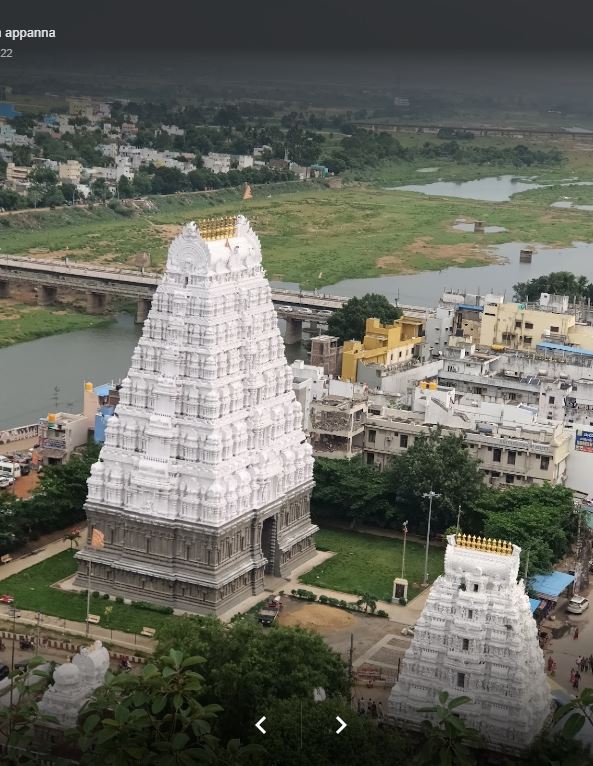
Gaali Gopuram
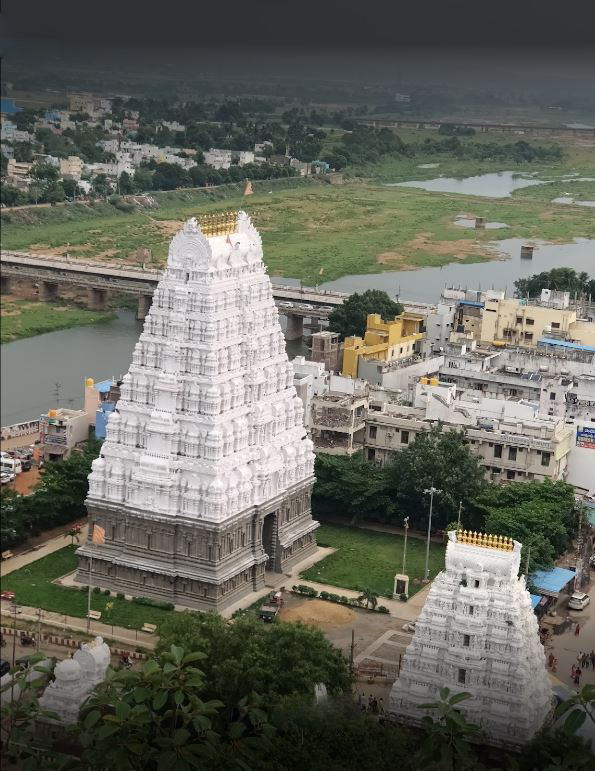
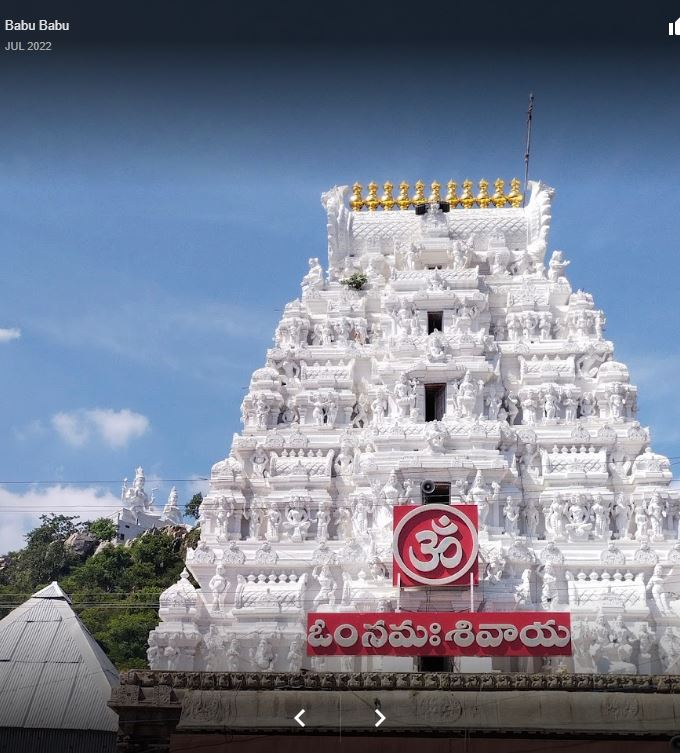
Sri Krishnadevaraya built a huge gopuram in 1516 a few feet away from the entrance to the temple.The entrance to the temple is crowned with a smaller tower.There is an underground Ganapati shrine in the outer prakaram, while in the innermost prakaram are the shrines of Shiva and Parvati. This ancient gopuram over the main gate, which is 36.5 meters (120 feet) high and the entire temple is carved.
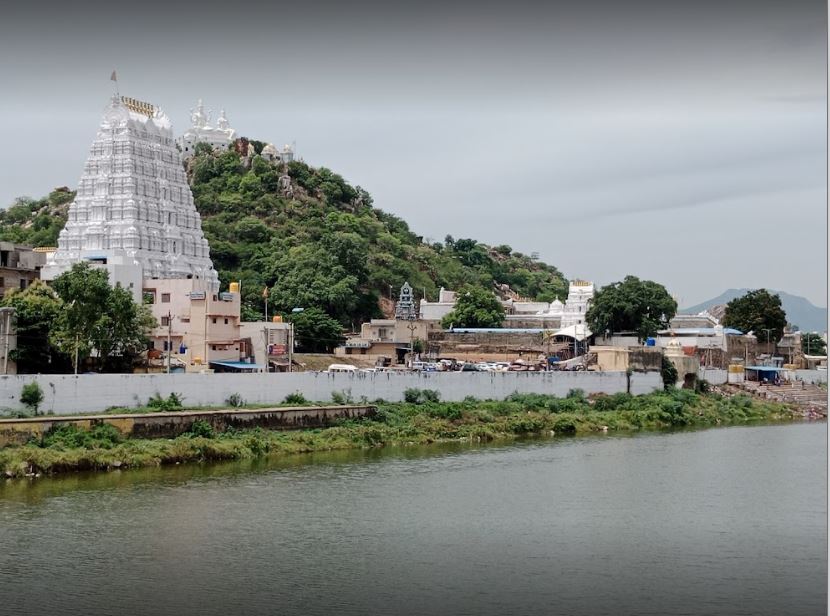
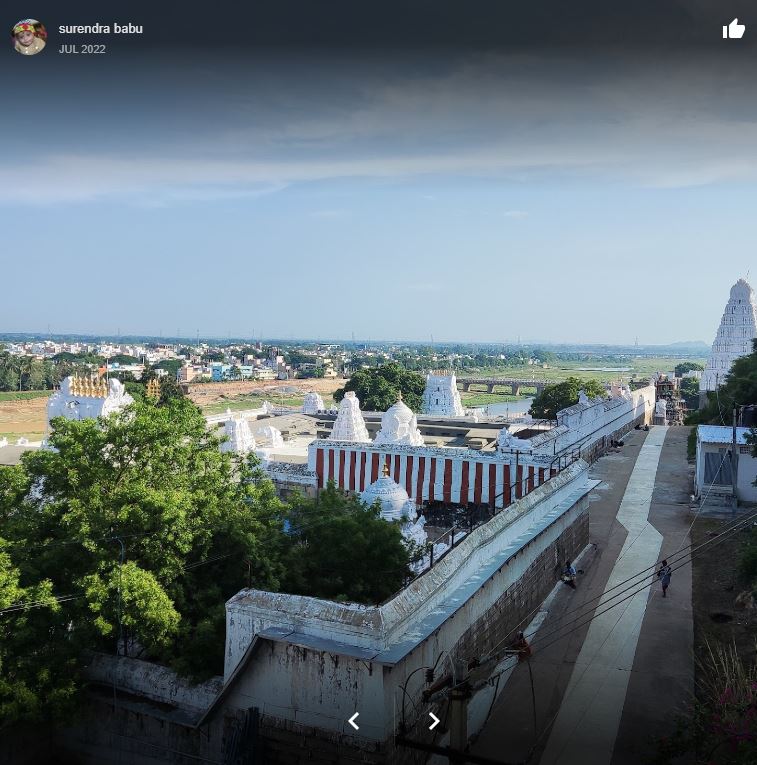
The vast west facing Kalahastiswara temple is built adjoining a hill, and on the banks of the river Swarnamukhi. At some points, the hill serves as the wall of the temple. The temple prakarams follow the contour of the adjoining hill and hence the temple plan is rather irregular. North of the temple is the Durgambika hill, south is the Kannappar hill and east is the Kumaraswamy hill.

Pathala Ganapathi
Pathala Ganapathi is associated with the old Sivalingam beneath the temple. You cannot see the Old SivaLingam (related to the old Story of SriKalaHasti) beneath the temple but you can imagine when you see the Lord Ganapathi.Patala Ganapati is a small underground temple located in the temple complex 20 feet below on a very narrow staircase.

Bhakta Kannappa
At Sri Kalahasti Lord Shiva created a tremor and the roof tops of the temple began to fall. All the sages ran away from the scene except Kannappa who covered the linga with his body to prevent it from any damage.In another incident, Kannappa plucked out one of his eyes and placed in the eye of Linga which was oozing with blood and tears. When the tears and the blood were still trickling from another eye, Kannappa decided to remove his second eye and placed one of his feet on the spot of the right eye of the Shiva Linga.
Before he could pull out his second eye with the arrow, Lord Shiva appeared and restored his eye while granting him a boon to occupy a place close to him.According to Swami Sivananda’s book,Sixty Three Nayanar Saints and some Saivite traditions believe that Kannappa was the reincarnation of Arjuna. Arjuna, worshipped Siva for seeking the Pasupatha Astra and failed to recognize Him in the form of a hunter. Thus, according to this tradition, Arjuna had to be born as a hunter and adore the Lord before attaining final liberation.
Meera Subramanian says,
The temple architecture and spiritual energy are amazing. Felt deeply connected.
Lakshmi Narayan says,
Every visit brings inner peace and strength. Jai Shri Ram ????
Suresh Kumar says,
The divine presence here is very powerful. A truly holy Swayambhu temple
Kavya Nair says,
Such a serene and spiritually uplifting temple. Felt calm and blessed.
Arjun Patel says,
A sacred place filled with devotion and history. Highly recommend visiting with family
Ananya Reddy says,
Blessed to have darshan here. The vibrations and positivity are beyond words.
Priya Iyer says,
An unforgettable spiritual experience. The atmosphere is so pure and peaceful.
Rahul Sharma says,
Felt divine energy as soon as I entered the temple. Truly a powerful Swayambhu kshetra. ????
Srikalahasti Temple Timings, which helps devotees to plan their Darshan. We will update this page on a weekly basis if there is any change in the temple timings
Darshan Waiting Time is 45 mins to 60 mins on during weekdays. 1 to 2 hours during weekends and 2 to 3 hours on festival days. Temple timings 5:00 am to 9:00 pm from Monday to Sunday.
Special Darshan Ticket Cost: Rs.200 per person.
Free Darshan is available for all the devotees.
Dress Code: Any decent outfit.
| S.No | Temple Opening Hours | Days |
| 1 | Monday | 6:00 a.m To 9:30 p.m |
| 2 | Tuesday | 6:00 a.m To 9:00 p.m |
| 3 | Wednesday | 6:00 a.m To 9:00 p.m |
| 4 | Thursday | 6:00 a.m To 9:00 p.m |
| 5 | Friday | 6:00 a.m To 9:00 p.m |
| 6 | Saturday | 6:00 a.m To 9:30 p.m |
| 7 | Sunday | 6:00 a.m To 9:30 p.m |
The above-mentioned timings might change on special days.
Morning Hours: 5:30 am to 6:15 am, 7:00 am to 8:00 am, 8:30 am to 11:30 am
Afternoon Hours: 12:00 pm to 5:00 pm
Evening Hours: 6:00 pm to 9:00 pm
Please note that Rahu Ketu Kala Sarpa Dosha Pooja is not performed on Sivaratri day. Rudrabhishekam will be performed in Ekantham during Brahmotsavam days. Lingodhavam on Sivaratri day will be done in Ekantham only.
| Pooja Timings | Pooja details | Day |
| 5:00 am | Temple opening hours | Daily |
| 5:00 am – 5:30 am | Go Pooja | Daily |
| 5:30 am – 6:00 am | Suprabhatha Seva | Daily |
| 6:00 am – 7:00 am | Abhishekam | Daily |
| 6:30 am – 8:30 pm | Sarva Darshan | Daily |
| 7:00 am – 6:00 pm | Rahu Ketu Kala Sarpa Dosha Pooja | Daily |
| 7:00 am – 8:00 am | Abhishekam | Daily |
| 9:00 am – 12:00 pm | Dakshinamurthy Abhishekam | Every Thursday |
| 9:30 am – 10:30 am | Abhishekam | Daily |
| 10:00 am – 11:30 am | Rudra Homam | Daily |
| 10:00 am – 10:30 am | Trisathi Archana | Daily |
| 10:00 am – 10:30 am | Saneeswara Abhishekam | Daily |
| 10:00 am – 11:30 am | Chandi Homam | Daily |
| 11:00 am – 12:00 pm | Nithya Kalyanam | Daily |
| 5:00 pm – 5:30 pm | Saneeswara Abhishekam | Daily |
| 5:00 pm – 5:30 pm | Trisathi Archana | Daily |
| 5:00 pm – 6:00 pm | Gnanaprasunambika Swarna Pushparchana | Every Friday |
| 6:00 pm – 7:00 pm | Pradosha Nandi Pooja | Every Trayodasi Day |
| 6:00 pm – 7:00 pm | Akhanda Deeparadhana | Daily |
Srikalahasti Temple Abhishekam Timings
| S.No | Day | Time |
| 1 | Monday | 6:00 am, 7:00 am, 10:00 am, 5:00 pm |
| 2 | Tuesday | 6:00 am, 7:00 am, 10:00 am, 5:00 pm |
| 3 | Wednesday | 6:00 am, 7:00 am, 10:00 am, 5:00 pm |
| 4 | Thursday | 6:00 am, 7:00 am, 10:00 am, 5:00 pm |
| 5 | Friday | 6:00 am, 7:00 am, 10:00 am, 5:00 pm |
| 7 | Saturday | 6:00 am, 7:00 am, 10:00 am, 5:00 pm |
| 8 | Sunday | 6:00 am, 7:00 am, 10:00 am, 5:00 pm |
Abhishekam Duration: 45 mins. Daily.
Abhishekam Ticket Cost Rs. 1500 per couple
Dress Code: Any decent outfit.
Temple remains open on all days. Even on Grahan Days.
Best Time to visit: Jan-Feb, Apr-Aug, Oct-Dec.
Address: Srikalahasti, Andhra Pradesh 517644, India
Phone: +91 85782 22240
Explore spiritual insights, reviews, and divine writings shared by our esteemed Priests & Guides.
Sri Ramananda shares the importance of morning poojas for spiritual awakening.

Guru Venkatesh explains how daily mantra chanting transforms mental and spiritual well-being.





Leave a Comment