202.Arulmigu Ramanathaswamy Temple
Speciality
Rama along with his wife Sita and Lakshmana installed and worshipped the lingam here to expiate the sin of Brahmahatya incurred while killing Ravana. Lord Rama has directed Hanuman to bring Lingam from the Himalayas. Since it took longer to bring the lingam Sita built a lingam made of sand from the nearby seashore which is also believed to be Ramalingam in the sanctum of the temple and the one brought by Hanuman from Kailash is called Vishwalingam.Rama instructed that the Vishwalingam should be worshipped first since it was brought by Hanuman.22 theerthams present inside the temple represent the 22 arrows of Sri Rama
Sthalam
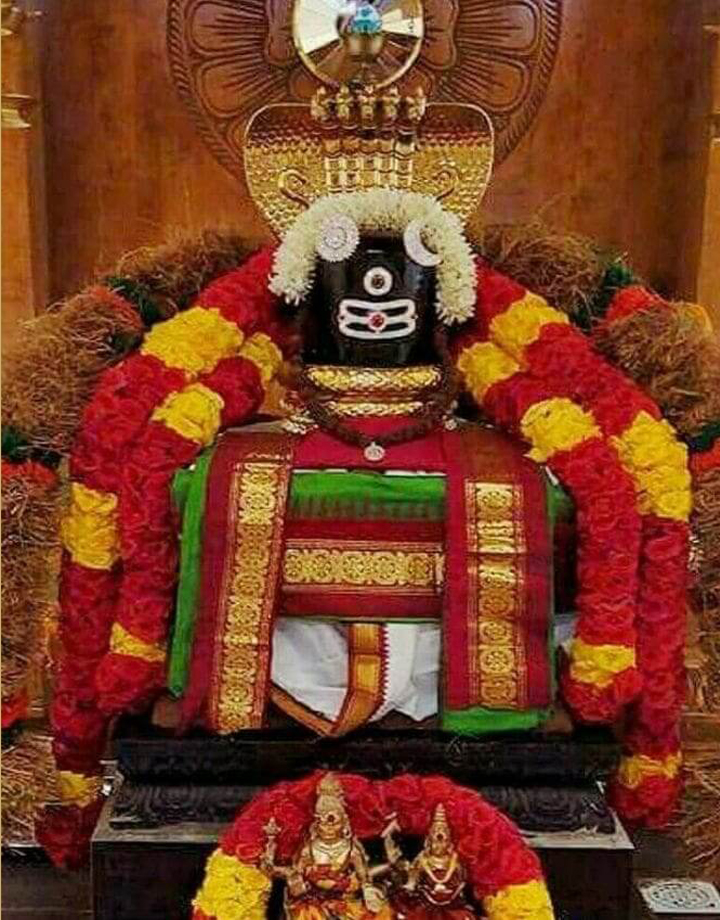
The primary deity of the temple is Ramanathaswamy (Shiva) in the form of lingam.There are two lingams inside the sanctum - one built by Rama, from sand, residing as the main deity, Ramalingam and the one brought by Hanuman from Kailash called Vishwalingam.Rama instructed that the Vishwalingam should be worshipped first since it was brought by Hanuman - the tradition continues even today.
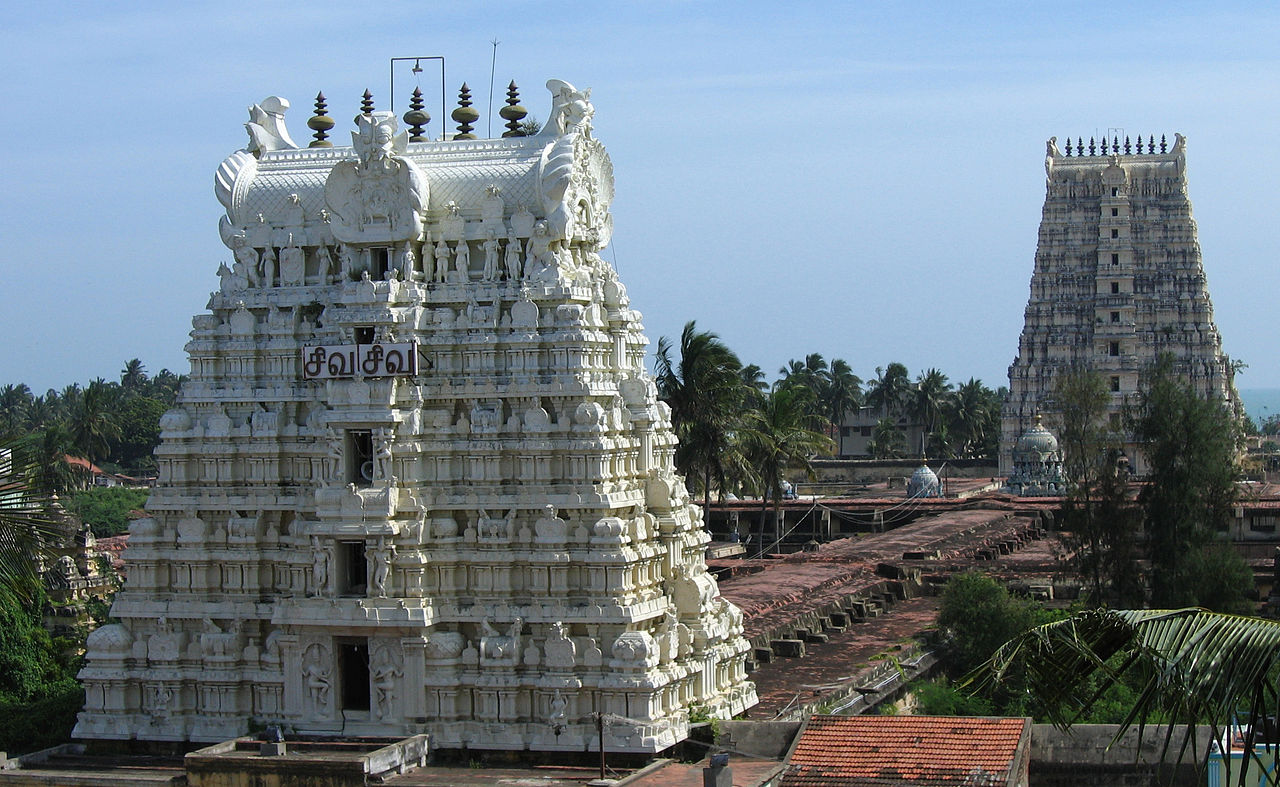
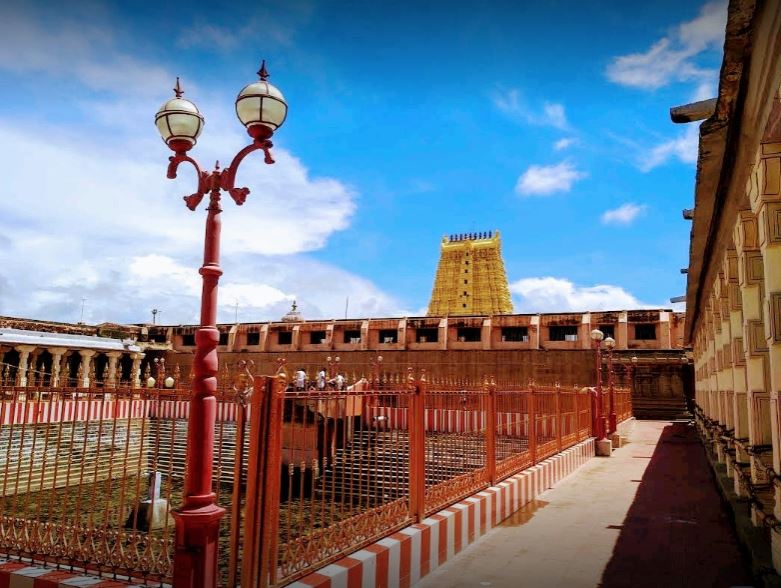
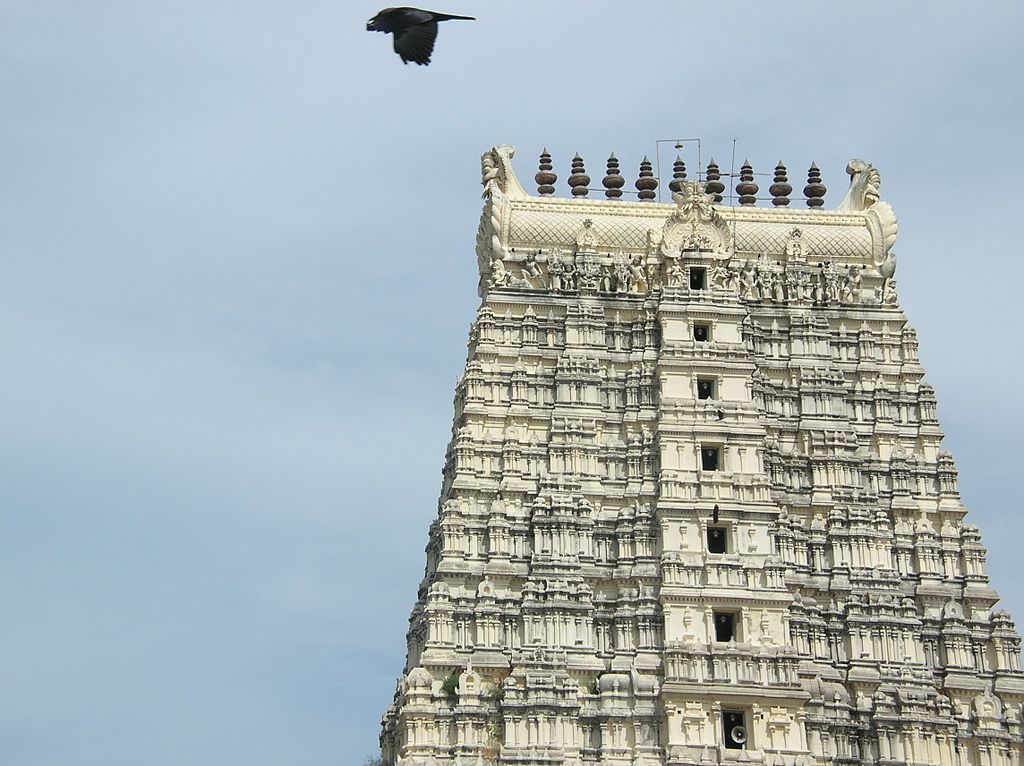
Like all ancient temples in South India, there is a high compound wall (madil) on all four sides of the temple premises measuring about 865 feet furlong from east to west and one furlong of 657 feet from north to south with huge towers (Gopurams) to the east and the west and finished gate towers to the north and south. The temple has striking long corridors in its interior, running between huge colonnades on platforms above five feet high.
The second corridor is formed by sandstone pillars, beams, and ceiling. The junction of the third corridor on the west and the paved way leading from the western gopuram to the Setumadhava shrine forms a unique structure in the form of a chess board, popularly known as Chokkattan Madapam, where the Utsava deities are adorned and kept during the Vasanthotsavam (Spring festival) and on the 6th day festival in Adi (July–August) and Masi (February–March) conducted by the Sethupathi of Ramnad.
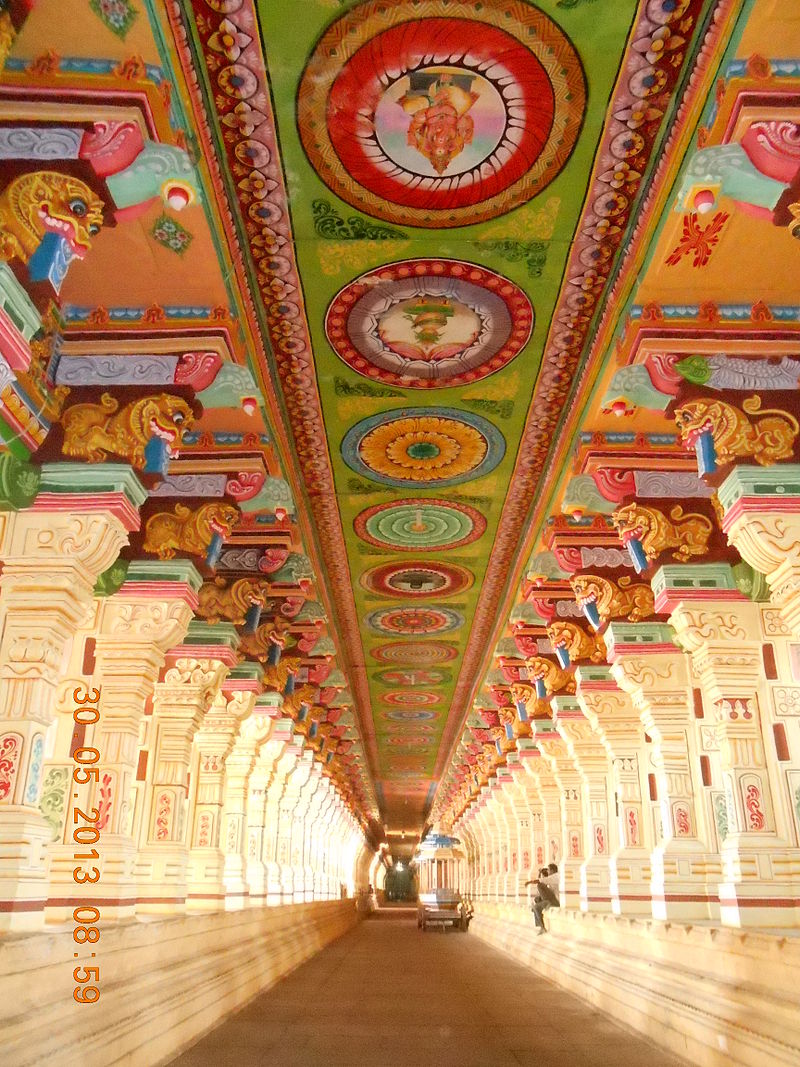
The outer set of corridors is reputed to be the longest in the world, measuring about 6.9 m in height, 400 feet each in the east and west and about 640 feet in the north and the south. The inner corridors are about 224 feet each in the east and the west and about 352 feet each in the north and the south.Their width varies from 15.5 feet to 17 feet in the east and west about 172 feet on the north and south with width varying 14.5 feet to 17 feet.
The total length of these corridors is thus 3850 feet. There are about 1212 pillars in the outer corridor.[9] Their height is about 30 feet from the floor to the center of the roof. The main tower or rajagopuram is 53 m tall. Most pillars are carved with individual compositions.[9] At the beginning, Ramanathaswamy Temple was a thatched shed. The present structure was the work of many individuals spread over a number of centuries.
The pride of place in the establishment of the Temple goes to the Setupatis of Ramanathapuram. In the seventeenth century, Dalavai Setupati built a portion of the main eastern Gopuram. In the late eighteenth century, the world-famous third corridor was constructed by Muthuramalinga Setupati who lived for forty-nine years and ruled between 1763 and 1795. The corridor was called "Chokkatan Mandapam". The Mukhya Pradhani (Chief Minister) was Muthuirullappa Pillai and the Chinna Pradhani (Deputy Chief Minister) was Krishna Iyengar. The Setupati's statue and those of his two Pradhanis (ministers) can be seen at the western entrance to the third corridor.
The composite columns of Virabhadra holding sword and horn are found be additions of the Vijayanayagara kings during the early 1500s. Similar columns of Virabhadra are found in Adikesava Perumal Temple at Thiruvattaru, Meenakshi Temple at Madurai, Nellaiappar Temple at Tirunelveli, Kasi Viswanathar temple at Tenkasi, Krishnapuram Venkatachalapathy temple, Soundararajaperumal temple at Thadikombu, Srivilliputhur Andal temple, Srivaikuntanathan Permual temple at Srivaikuntam, Avudayarkovil, Vaishnava Nambi and Thirukurungudivalli Nachiar temple at Thirukkurungudi.
There are separate shrines for Ramanathaswamy and his consort goddess Parvathavardhini separated by a corridor.There are separate shrines for the goddess Vishalakshi, the utsava images, sayanagriha, Vishnu and Ganesha. The samadhi of the great Yogi Patanjali is said to be at this temple and there is a separate shrine for him here. There are various halls inside the temple, namely Anuppu Mandapam, Sukravara Mandapam, Setupati Mandapam, Kalyana Mandapam, and Nandi Mandapam.
There are sixty-four Tīrthas (holy water bodies) in and around the island of Rameswaram, Tamil Nadu, India.According to Skānda Purāṇa, twenty-four of them are important. Bathing in these Tīrthas is a major aspect of the pilgrimage to Rameswaram and is considered equivalent to penance.The number 22 indicates the 22 arrows in Rama's quiver.
The first and major one is called Agni Theertham, the sea (Bay of Bengal).Rameswaram is one of the few temples that has the distinction of being the stala, Murthy, Theertham. Ramanathaswamy Temple Theertham is very special. There are 22 theerthams in the form of a pond and a well. These 22 theerthams represent the 22 arrows of Sri Rama.
The temple is one of the holiest Hindu Char Dham (four divine sites) sites comprising Badrinath, Puri, Dwarka and Rameshwaram.Though the origins are not clearly known, the Advaita school of Hinduism established by Sankaracharya, who created Hindu monastic institutions across India, attributes the origin of Char Dham to the seer.
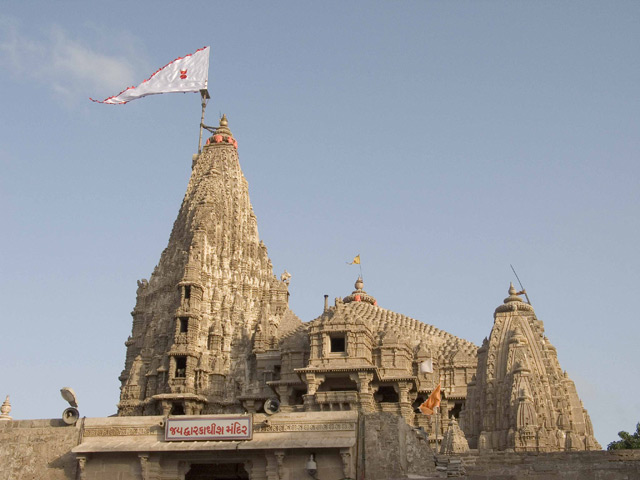
The four monasteries lie across the four corners of India and their attendant temples are Badrinath Temple at Badrinath in the North, Jagannath Temple at Puri in the East, Dwarakadheesh Temple at Dwarka in the West and Ramanathaswamy Temple at Rameswaram in the South. The temples are revered by the various spiritual traditions of Hinduism, such as Saivism and Vaishnavism.
The Char Dham pilgrimage is an all Hindu affair.There are four abodes in the Himalayas called Chota Char Dham (Chota meaning small): Badrinath, Kedarnath, Gangotri and Yamunotri - all of these lie at the foothills of Himalayas.The name Chota was added during the mid of 20th century to differentiate the original Char Dhams. The journey across the four cardinal points in India is considered sacred by Hindus who aspire to visit these temples once in their lifetime.Traditionally the trip starts at the eastern end from Puri, proceeding in clockwise direction in a manner typically followed for circumambulation in Hindu temples.
The temple in its current shape is believed to have been built during the 17th century, while Fergusson believes the small vimana in the west corridor belongs to the 11th or 12th century.The temple is said to have been sanctioned for construction by King Kizhavan Sethupathi or Raghunatha Kilavan. The contribution of the Jaffna kings of Pandya Dynasty to the temple was considerable.[4] King Jeyaveera Cinkaiariyan (1380–1410 CE) shipped stone blocks from Koneswaram temple,
Trincomalee to renovate the temple's sanctum sanctorum. Jeyaveera Cinkaiariyan's successor Gunaveera Cinkaiariyan (Pararacacekaran V), a trustee at Rameswaram who also oversaw structural development of this temple and the promotion of Saivite beliefs donated part of his revenue to Koneswaram. Especially to be remembered are the immense sums that were spent during the tenure of Pradani Muthirulappa Pillai towards the restoration of the Pagodas which were falling into ruins and the splendid Chockattan Mantapam or the cloistered precincts of the temple at Rameswaram that he finally completed.
The rulers of Sri Lanka also contributed to the temple; Parakrama Bahu (1153–1186 CE) was involved in the construction of the sanctum sanctorum of the temple. Also, Sri Lankan king Nissanka Malla, contributed to the temple's development by making donations and sending workers.Pappakudi a village was donated as a grant to Rameshwaram Temple and one Deva Venkala Perumal Ramanathar in (1667 CE) by Perumal Servaikaran Son of Sokkappan Servaikarar who belongs to Pandiyur. They are local Chieftain under Tirumalai Regunatha Sethupathy Thevar Rein in Ramnad Kingdom.
The grant details are published by Government Press, Madras Presidency for Archeological Survey of India in 1885. Along with Pappakudi, Anandur and Urasur villages are also donated to Rameshwaram Temple. These Villages falls under Melaimakani Seermai province of Radhanallur Division The temple is one of the most famous pilgrimage sites and has several historical references about it. The Maratha kings who ruled Thanjavur established chatrams or rest houses throughout Mayiladuthurai and Rameswaram between 1745 and 1837 CE and donated them to the temple
.
Era
Information not available.
Puranam
Ramanathaswamy Temple is a Hindu temple dedicated to the god Shiva located on Rameswaram island in the state of Tamil Nadu, India. It is also one of the twelve Jyotirlinga temples. It is one of the 275 Paadal Petra Sthalams, where three of the most revered Nayanars (Saivite saints), Appar, Sundarar and Tirugnana Sambandar, have glorified the temple with their songs.
The temple was expanded during the 12th century by the Pandya Dynasty, and its principal shrine’s sanctum was renovated by Jeyaveera Cinkaiariyan and his successor Gunaveera Cinkaiariyan, monarchs of the Jaffna kingdom. The temple has the longest corridor among all Hindu temples in India. It was built by King Muthuramalinga Sethupathiy.
The temple, located in Rameswaram, is considered a holy pilgrimage site for Shaivites, Vaishnavites and Smarthas. Mythological accounts depict the presiding deity, the Lingam of Ramanathaswamy (Shiva) as having been established and worshiped by Rama, before he crossed his bridge to the present-day island of Sri Lanka.
According to Hindu epic Ramayana, Rama, the seventh avatar of the god Vishnu, prayed to Shiva here to absolve any sins that he might have committed during his war against the demon-king Ravana in Sri Lanka. According to the Puranas (Hindu scriptures), upon the advice of sages, Rama along with his wife Sita and his brother Lakshmana, installed and worshipped the lingam (an iconic symbol of Shiva) here to expiate the sin of Brahmahatya incurred while killing Ravana (who was a Brahmin and son of Vishrava).
To worship Shiva, Rama directed his trusted lieutenant Hanuman (avatar of Shiva himself) to bring it from Himalayas. Since it took longer to bring the lingam, Sita built a lingam made of sand from the nearby seashore, which is also believed to be the one in the sanctum of the temple. This account is well supported by the original Ramayana authored by Valmiki were it is written in Yudha Kanda. According to another version, as quoted in Adhyatma Ramayana, Rama installed the lingam before the construction of the bridge to Lanka.
Varnam
Rama along with his wife Sita and Lakshmana installed and worshipped the lingam here to expiate the sin of Brahmahatya incurred while killing Ravana. Lord Rama has directed Hanuman to bring Lingam from the Himalayas. Since it took longer to bring the lingam Sita built a lingam made of sand from the nearby seashore which is also believed to be Ramalingam in the sanctum of the temple and the one brought by Hanuman from Kailash is called Vishwalingam.Rama instructed that the Vishwalingam should be worshipped first since it was brought by Hanuman.22 theerthams present inside the temple represent the 22 arrows of Sri Rama
Highlights
Information not available.
Sevas
Information not available.
Timings
Nadai Opening Time 04:00 AM IST - 01:00 PM IST03:00 PM IST - 09:00 PM ISTNadai Closing Time05:30 AM IST - 05:30 AM ISTThe temple opens daily at 4.00 AM.Devotees are allowed for dharshan by 5.00 AM . First darshan of the day starts with
Spatiga linga dharshan from 5.00 AM to 6.00 AM.
The moolasthana Dharshan starts from 6.00 AM upto 1.00 PM The temple closes at 1.00 PM and again opened at 3.00 PM .Devotees are allowed for darshan at 3.15 PM upto 8.45 PM .
The temple is closed by 9.00 PM daily.
THEERTHAM
22 Holy Theerthams located inside the temple premises The pilgrims are allowed to take bath in the theerthams from 5.30 am to 12.30 pm and 3.00 pm to 7.00 pm.
Address
Rameswaram, Tamil Nadu 623526, India
Phone: +91 4573 221 223
Creator: , 41363, TN, IN
Gallery







Leave a Comment