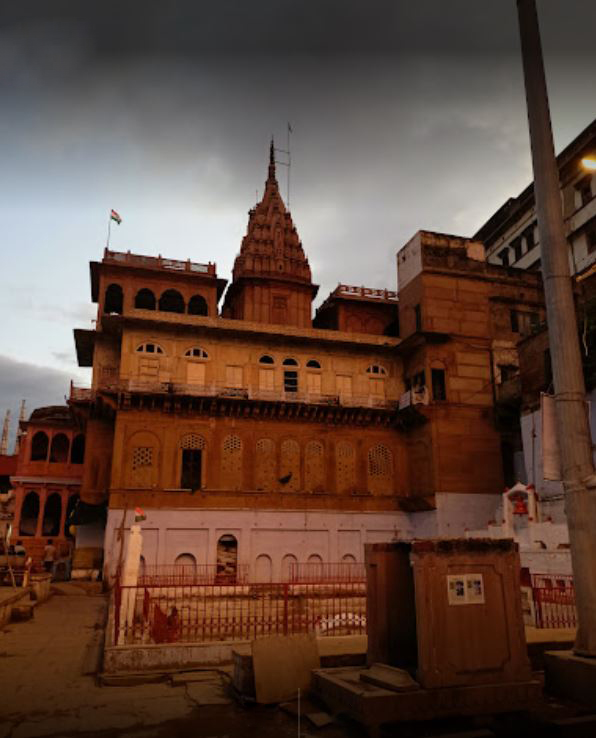
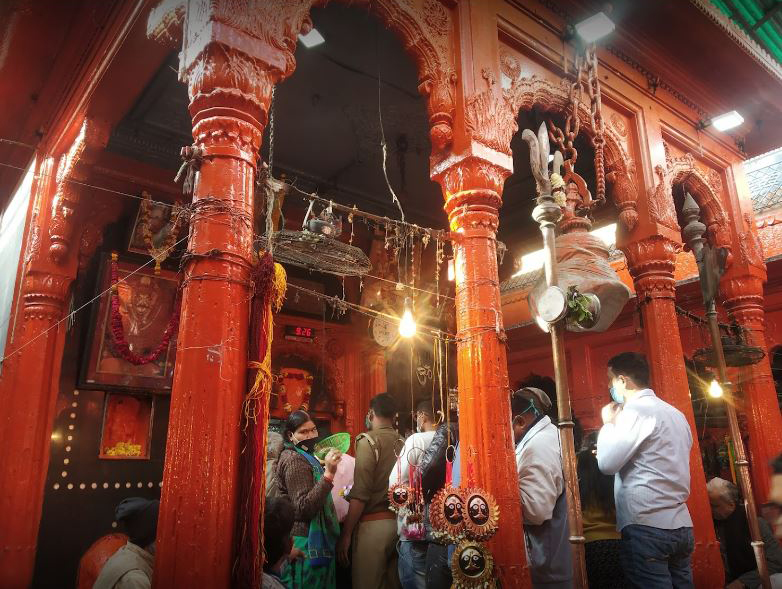
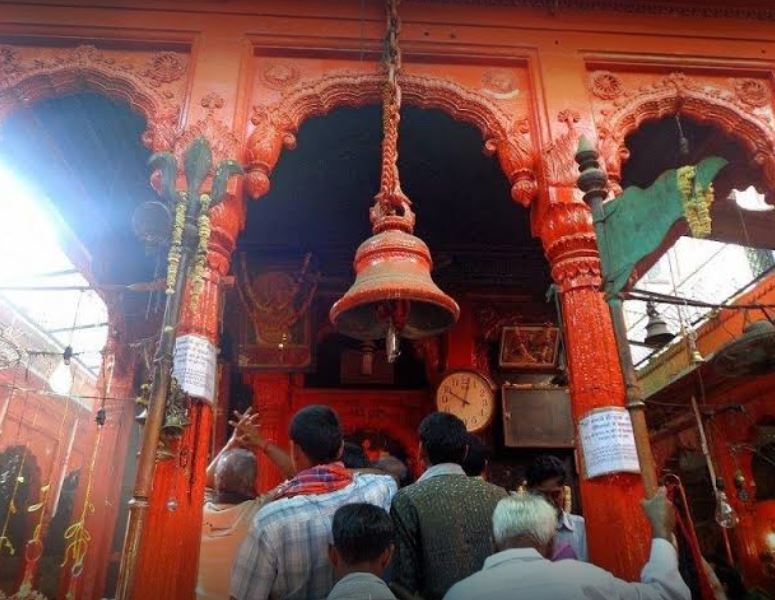
Kaal Bhairav Mandir is one of the oldest Shiva temples in Varanasi, India. Situated in Bharonath, Vishweshwarganj (Varanasi), this temple has great historical and cultural importance in Hinduism; especially amongst the locals. The temple is dedicated to Bhairava (Kaal Bhairav), a fierce form of Shiva and wears a garland of skulls and carries a club of peacock feathers.
The word "Kaal" means both "death" and "fate". Kaal Bhairav also means the one whom even death Fears It is believed that even death is afraid of Kaal Bhairav.
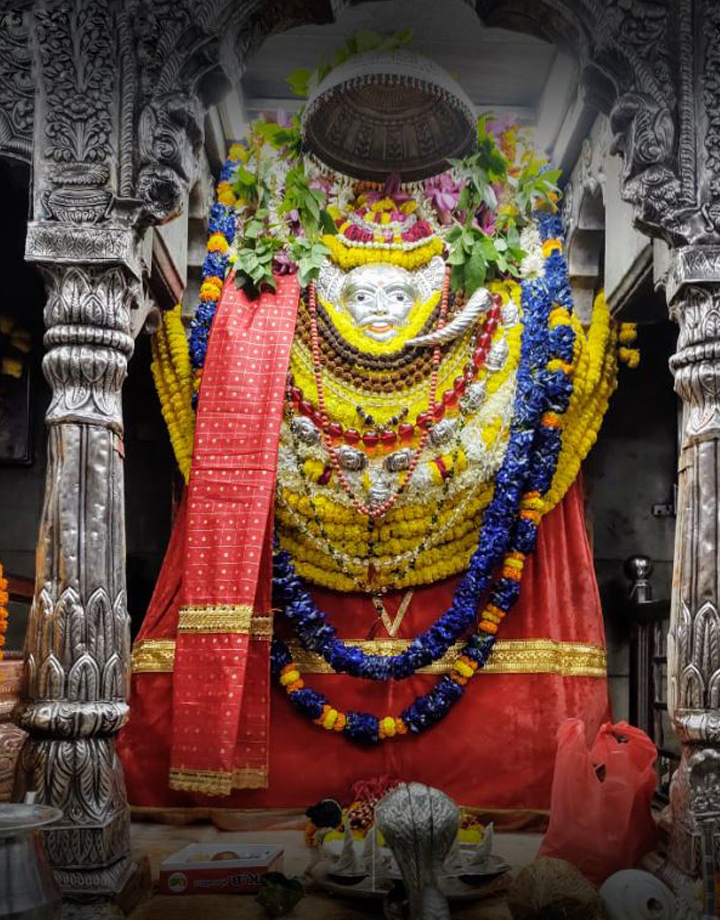
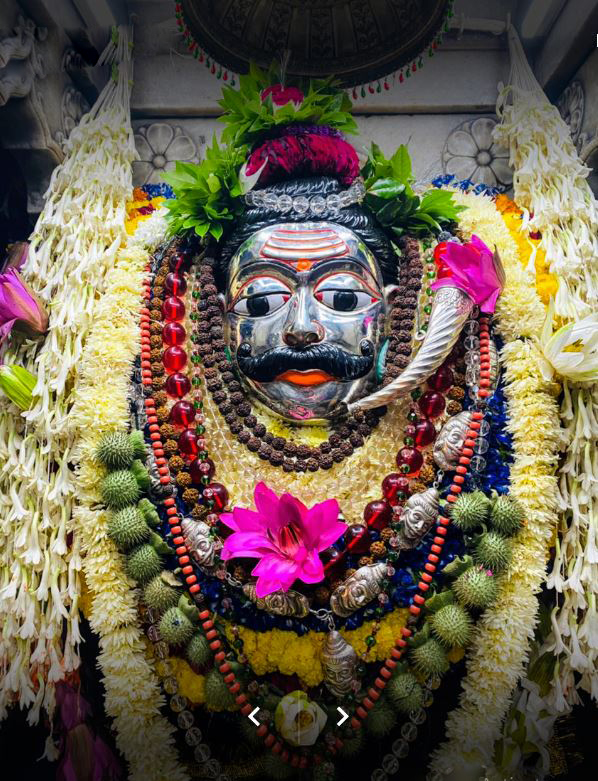
Housed in the inner sanctum of the temple is a silver faced idol of Kal Bhairav who is seated on his vahana (vehicle), a dog and is holding a trident. Only the face of the icon decorated (with garlands) is visible to the visitors through the doorway. Rest of the icon is covered with a piece of cloth. On the rear door of the temple, there is an icon of Kshetrapal Bhairav, another aspect of Bhairava.
According to Shivamahapurana, tKaal Bhairav is often depicted in his idol wearing the Kapalik form, having snake coiled earings in his ear, trieyes like lotus blossoms, Mahakal, accomplished, Shashi Bhushan, a Garland in his neck which was previously originated from the bones of the Brahma, carrying a trident and the severed fifth head of Lord Brahma.
Hence, he is considered to be the vanquisher of death. His third eye represents eternal supreme wisdom. Bhairav manifestation is traced in the Shiva Mahapuran. Kaal Bhairav is the form of Lord Shiva which can be invoked for destroying negative energies and for protecting the devotees as well.
There are many interesting legends related to Kaal Bhairav, one of the eight avatars of Lord Shiva. The origin of the mighty god is attributed to a tale in the Shiv Mahapuran.
Once sage Agastya asked Skanda ji that who is this bhairav in Kashi. How they appear and how to worship them? Skanda said, in ancient times, several great Sages sitting on the top of Sumeru Mountain desired to know from Lord Brahma as to who was indestructible and supreme. Lord Brahma proclaimed himself to be that superior person. On hearing this, Yagyeshwar (symbolic of Lord Narayan) reprimanded Lord Brahma for his hasty and audacious utterances and said “Why are you saying these things without knowing about it? It is not appropriate for a yogi like you to have such irrelevant talks.
I am the supreme among all.With the mutual intention of victory, both of them asked the same question to the four Vedas.
Rig Veda replied, “Within which all the ghosts are located, from which all of these things are promulgated, which is called by the word “tat” by various priests, He is one and only Paramtatva Rudra.
The Yajurveda replied, “Those who are being meditated by all Yagnas and Yogis, with whose force we are considered to be the evidence, the same paramtatva Shiva is supreme.”
Sam Veda stated that the respected figure who controls the entire world, who is contemplating by various yogis, with whose light the world shines, that paramtatva is none other than Triambak.”
Finally, Atharva Veda said, all human beings can see the Lord through Bhakti Marg and such a deity who can remove all the worries of human beings, that paramtatva is indeed Shankar. In a nut shell, all the four Vedas proclaimed that Lord Shiva is the ultimate being.
Both Lord Brahma and Yagya Narayan started laughing in disbelief. Shortly Lord Shiva appeared as a powerful divine light in their midst. Lord Brahma stared at that being furiously with his fifth head. Lord Shiva immediately created a new being and stated that he (the new being) will be the King of Kaal and will be known as Kaal Bhairav. (Here Kaal is referred to final time viz. death). Lord Shiva further stated that Kaal Bhairav will remove all the sins of his devotees immediately and therefore, he will be known as Paap Bhakshak.
Lord Shiva also granted the lordship of Kashi to him. Lord Shiva ordered Kaal Bhairav to punish the Pankajjanma (Brahma).
Meanwhile, Lord Brahma’s fifth head was still burning with fury and Kaal Bhairav plucked that head with the little finger of his left hand (just as we pluck flowers from the garden). The people present there, along with Yagyamurtidhaari Vishnu, immediately started singing praises of Lord Shiva. Lord Shiva said to Bhairav that both Yagyaprush and lord Brahma are honorable to you, You will hold the head of lord brahma, ask for alms always and have customary fasting to remove the sin of brahmahatya and set an example for the world.
You can go anywhere but the sin of Brahmahatya (affliction on account of hurting a Brahmin) will never leave you behind. Lord Shiva created a dangerous and fierce looking female figure, named Brahmahatya and asked her to follow Kaal Bhairav wherever he went. But, you will not be able to enter Moksh City Varanasi.
By the proximity of Brahmahatya Bhairav become dark. As Directed by Lord Shiva, Kaal Bhairav, with Brahma’s head in his hand and having customary fasting, started going around various places in the world, took bath in various Teerths, worshipped various Lords, nevertheless saw that Brahma Hatya was following him all along. He could not get rid of that affliction, that sin.
Finally, Kaal Bhairav reached the Moksha Puri, Kashi. The moment Kaal Bhairav entered Kashi, Brahma Hatya started shouting, screaming and finally disappeared into the netherworld. The head (Kapal) of Brahma, fell at a place which was called Kapal Mochan and there was a Teerth which was later called Kapal Mochan Teerth.
Then onwards Kaal Bhairav stationed himself permanently in Kashi, giving shelter to all his devotees. Those living in or visiting Kashi, must worship Kaal Bhairav and he grants protection to all his devotees.
Once, the gods Brahma and Vishnu were competing for supremacy. Then Shiva appeared as a powerful divine light between the duo. An angry Brahma stared at the pillar of light with his 5th head, which started to burn out of anger. Shiva has instantly created the new being Bhairava or Kaal Bhairav (King of "Kaal": "Kaal Bhairav"), who decapitated Brahma's 5th head. However, the head stuck to Kaal Bhairav's hand.
Shiva then ordered Kaal Bhairav to go to various places but Brāhmanahatya, the sin of beheading Brahma personified as a gory woman, followed him until he reached Varanasi where Brahma's head fell on the ground. The place is called "Kapal Mochan Teerth". He was freed of the sin of Brāhmanahatya as he entered Varanasi. Shiva then pronounced that "Kaal Bhairav" will forever be in Varanasi in order to remove sins of his disciples.
Meera Subramanian says,
The temple architecture and spiritual energy are amazing. Felt deeply connected.
Lakshmi Narayan says,
Every visit brings inner peace and strength. Jai Shri Ram ????
Suresh Kumar says,
The divine presence here is very powerful. A truly holy Swayambhu temple
Kavya Nair says,
Such a serene and spiritually uplifting temple. Felt calm and blessed.
Arjun Patel says,
A sacred place filled with devotion and history. Highly recommend visiting with family
Ananya Reddy says,
Blessed to have darshan here. The vibrations and positivity are beyond words.
Priya Iyer says,
An unforgettable spiritual experience. The atmosphere is so pure and peaceful.
Rahul Sharma says,
Felt divine energy as soon as I entered the temple. Truly a powerful Swayambhu kshetra. ????
| Sunday | 4am–1pm, 3–11pm |
| Monday | 5:30am–1pm, 3–10:30pm |
| Tuesday | 4am–1pm, 3–11pm |
| Wednesday | 5:30am–1pm, 3–10:30pm |
| Thursday | 5:30am–1pm, 3–10:30pm |
| Friday | 5:30am–1pm, 3–10:30pm |
| Saturday | 5:30am–1pm, 3–10:30pm |
Pandeypur Rd, Golghar, Naibasti, Varanasi, Uttar Pradesh 221002
Contact :&
Explore spiritual insights, reviews, and divine writings shared by our esteemed Priests & Guides.
Sri Ramananda shares the importance of morning poojas for spiritual awakening.
Guru Venkatesh explains how daily mantra chanting transforms mental and spiritual well-being.
The word "Kaal" means both "death" and "time". Kaal Bhairav also means the one who removes the fear of both death and time. Pujari of temple takes the saucer near the deity's lips, which have a slit. He tilts the plate a bit, and the liquor starts disappearing.
Kaal Bhairav Mandir is one of the oldest Shiva temples in Varanasi, India. Situated in Bharonath, Vishweshwarganj (Varanasi), this temple has great historical and cultural importance in Hinduism; especially amongst the locals. The temple is dedicated to Bhairava (Kaal Bhairav), a fierce form of Shiva and wears a garland of skulls and carries a club of peacock feathers.
The word "Kaal" means both "death" and "fate". Kaal Bhairav also means the one whom even death Fears It is believed that even death is afraid of Kaal Bhairav.
Housed in the inner sanctum of the temple is a silver faced idol of Kal Bhairav who is seated on his vahana (vehicle), a dog and is holding a trident. Only the face of the icon decorated (with garlands) is visible to the visitors through the doorway. Rest of the icon is covered with a piece of cloth. On the rear door of the temple, there is an icon of Kshetrapal Bhairav, another aspect of Bhairava.
According to Shivamahapurana, tKaal Bhairav is often depicted in his idol wearing the Kapalik form, having snake coiled earings in his ear, trieyes like lotus blossoms, Mahakal, accomplished, Shashi Bhushan, a Garland in his neck which was previously originated from the bones of the Brahma, carrying a trident and the severed fifth head of Lord Brahma.
Hence, he is considered to be the vanquisher of death. His third eye represents eternal supreme wisdom. Bhairav manifestation is traced in the Shiva Mahapuran. Kaal Bhairav is the form of Lord Shiva which can be invoked for destroying negative energies and for protecting the devotees as well.
Information not available.
There are many interesting legends related to Kaal Bhairav, one of the eight avatars of Lord Shiva. The origin of the mighty god is attributed to a tale in the Shiv Mahapuran.
Once sage Agastya asked Skanda ji that who is this bhairav in Kashi. How they appear and how to worship them? Skanda said, in ancient times, several great Sages sitting on the top of Sumeru Mountain desired to know from Lord Brahma as to who was indestructible and supreme. Lord Brahma proclaimed himself to be that superior person. On hearing this, Yagyeshwar (symbolic of Lord Narayan) reprimanded Lord Brahma for his hasty and audacious utterances and said “Why are you saying these things without knowing about it? It is not appropriate for a yogi like you to have such irrelevant talks.
I am the supreme among all.With the mutual intention of victory, both of them asked the same question to the four Vedas.
Rig Veda replied, “Within which all the ghosts are located, from which all of these things are promulgated, which is called by the word “tat” by various priests, He is one and only Paramtatva Rudra.
The Yajurveda replied, “Those who are being meditated by all Yagnas and Yogis, with whose force we are considered to be the evidence, the same paramtatva Shiva is supreme.”
Sam Veda stated that the respected figure who controls the entire world, who is contemplating by various yogis, with whose light the world shines, that paramtatva is none other than Triambak.”
Finally, Atharva Veda said, all human beings can see the Lord through Bhakti Marg and such a deity who can remove all the worries of human beings, that paramtatva is indeed Shankar. In a nut shell, all the four Vedas proclaimed that Lord Shiva is the ultimate being.
Both Lord Brahma and Yagya Narayan started laughing in disbelief. Shortly Lord Shiva appeared as a powerful divine light in their midst. Lord Brahma stared at that being furiously with his fifth head. Lord Shiva immediately created a new being and stated that he (the new being) will be the King of Kaal and will be known as Kaal Bhairav. (Here Kaal is referred to final time viz. death). Lord Shiva further stated that Kaal Bhairav will remove all the sins of his devotees immediately and therefore, he will be known as Paap Bhakshak.
Lord Shiva also granted the lordship of Kashi to him. Lord Shiva ordered Kaal Bhairav to punish the Pankajjanma (Brahma).
Meanwhile, Lord Brahma’s fifth head was still burning with fury and Kaal Bhairav plucked that head with the little finger of his left hand (just as we pluck flowers from the garden). The people present there, along with Yagyamurtidhaari Vishnu, immediately started singing praises of Lord Shiva. Lord Shiva said to Bhairav that both Yagyaprush and lord Brahma are honorable to you, You will hold the head of lord brahma, ask for alms always and have customary fasting to remove the sin of brahmahatya and set an example for the world.
You can go anywhere but the sin of Brahmahatya (affliction on account of hurting a Brahmin) will never leave you behind. Lord Shiva created a dangerous and fierce looking female figure, named Brahmahatya and asked her to follow Kaal Bhairav wherever he went. But, you will not be able to enter Moksh City Varanasi.
By the proximity of Brahmahatya Bhairav become dark. As Directed by Lord Shiva, Kaal Bhairav, with Brahma’s head in his hand and having customary fasting, started going around various places in the world, took bath in various Teerths, worshipped various Lords, nevertheless saw that Brahma Hatya was following him all along. He could not get rid of that affliction, that sin.
Finally, Kaal Bhairav reached the Moksha Puri, Kashi. The moment Kaal Bhairav entered Kashi, Brahma Hatya started shouting, screaming and finally disappeared into the netherworld. The head (Kapal) of Brahma, fell at a place which was called Kapal Mochan and there was a Teerth which was later called Kapal Mochan Teerth.
Then onwards Kaal Bhairav stationed himself permanently in Kashi, giving shelter to all his devotees. Those living in or visiting Kashi, must worship Kaal Bhairav and he grants protection to all his devotees.
Once, the gods Brahma and Vishnu were competing for supremacy. Then Shiva appeared as a powerful divine light between the duo. An angry Brahma stared at the pillar of light with his 5th head, which started to burn out of anger. Shiva has instantly created the new being Bhairava or Kaal Bhairav (King of "Kaal": "Kaal Bhairav"), who decapitated Brahma's 5th head. However, the head stuck to Kaal Bhairav's hand.
Shiva then ordered Kaal Bhairav to go to various places but Brāhmanahatya, the sin of beheading Brahma personified as a gory woman, followed him until he reached Varanasi where Brahma's head fell on the ground. The place is called "Kapal Mochan Teerth". He was freed of the sin of Brāhmanahatya as he entered Varanasi. Shiva then pronounced that "Kaal Bhairav" will forever be in Varanasi in order to remove sins of his disciples.
The word "Kaal" means both "death" and "time". Kaal Bhairav also means the one who removes the fear of both death and time. Pujari of temple takes the saucer near the deity's lips, which have a slit. He tilts the plate a bit, and the liquor starts disappearing.
Information not available.
| Sunday | 4am–1pm, 3–11pm |
| Monday | 5:30am–1pm, 3–10:30pm |
| Tuesday | 4am–1pm, 3–11pm |
| Wednesday | 5:30am–1pm, 3–10:30pm |
| Thursday | 5:30am–1pm, 3–10:30pm |
| Friday | 5:30am–1pm, 3–10:30pm |
| Saturday | 5:30am–1pm, 3–10:30pm |
Pandeypur Rd, Golghar, Naibasti, Varanasi, Uttar Pradesh 221002
Contact :&, 347, Information not available., IN


Leave a Comment