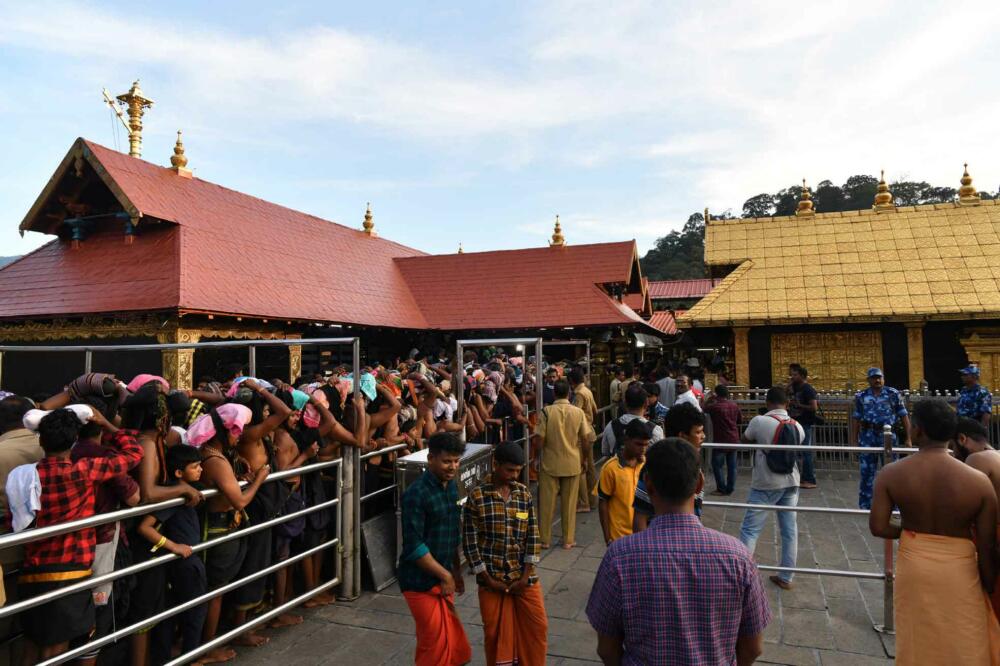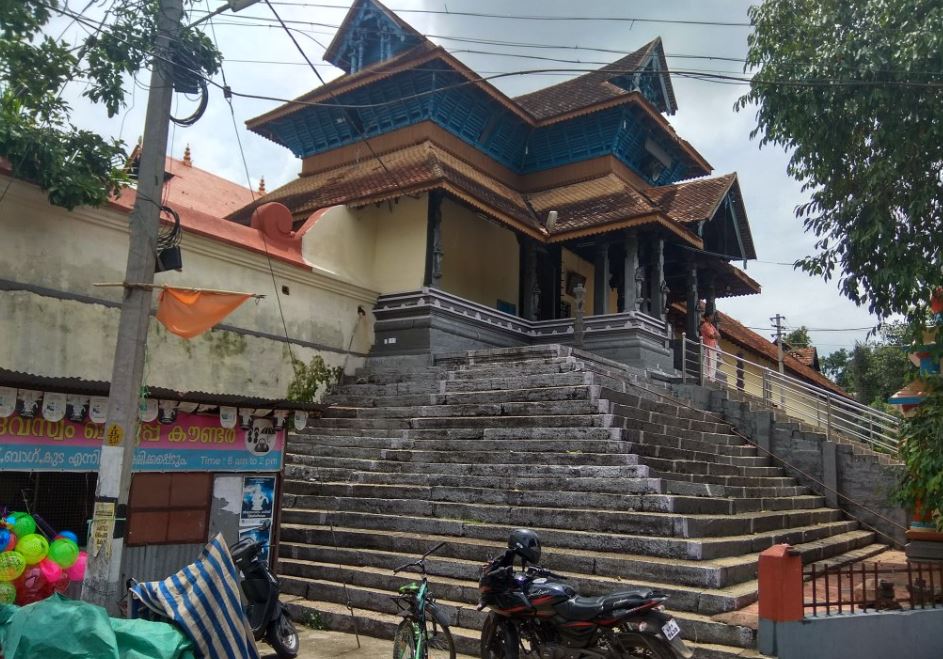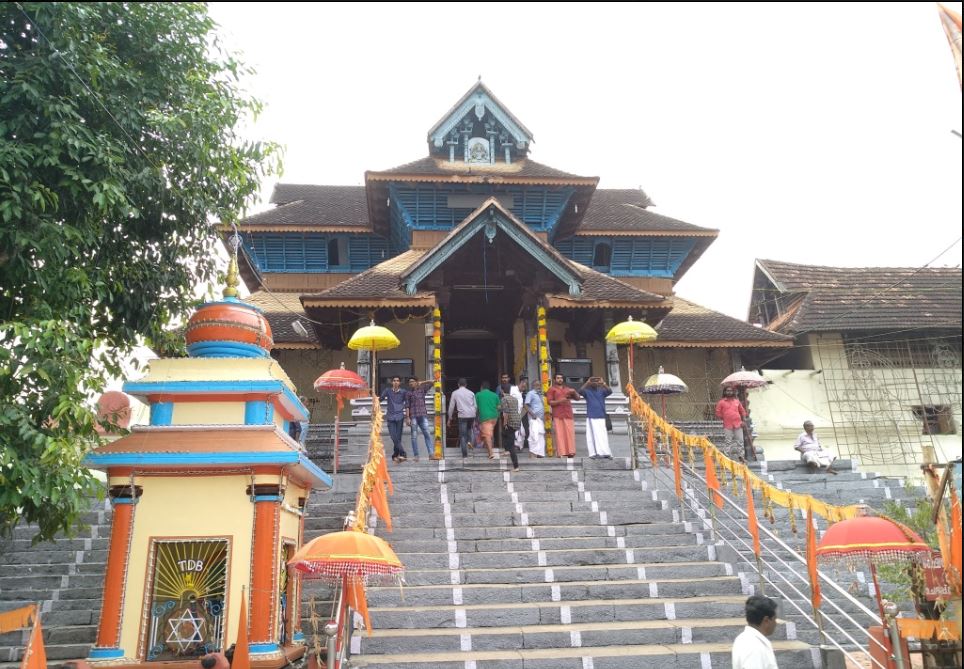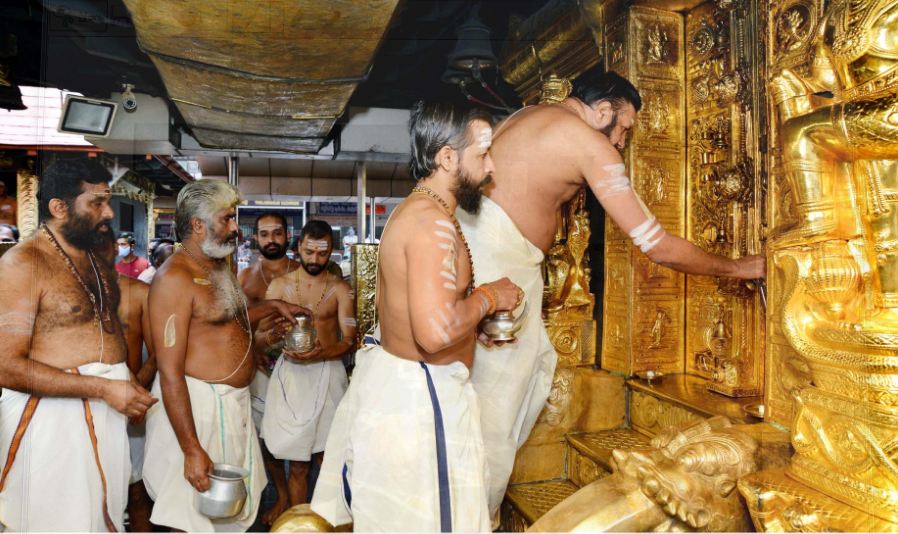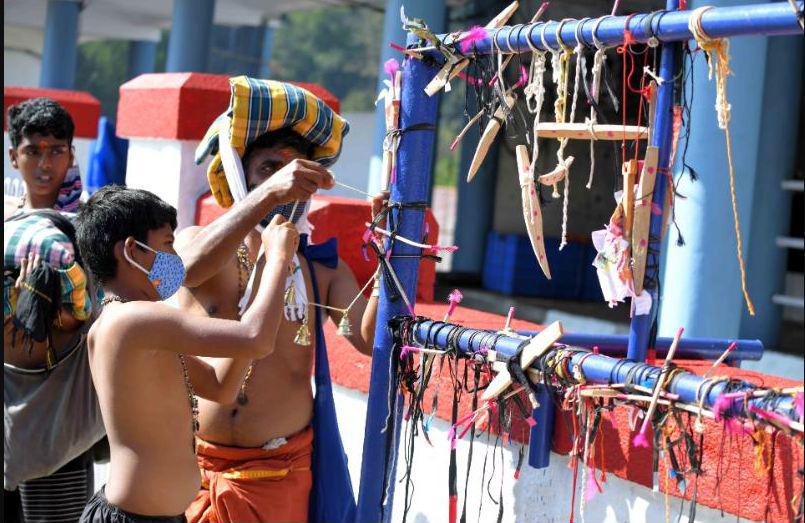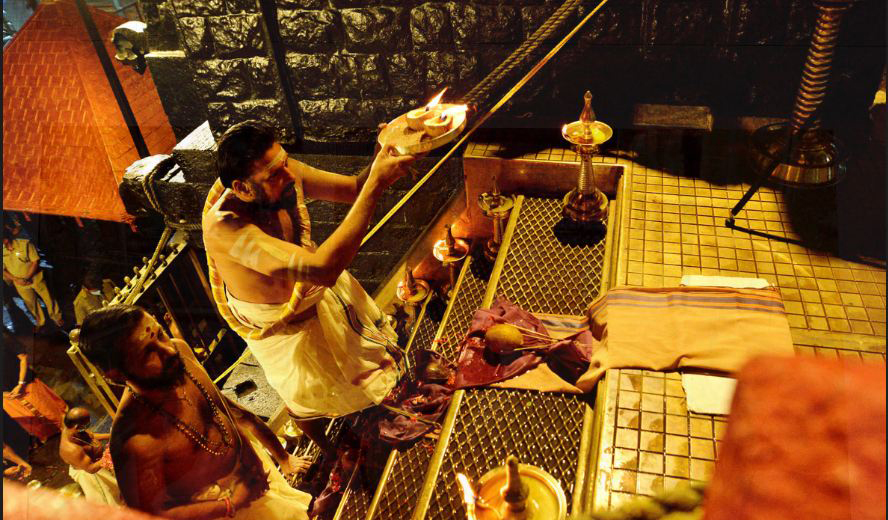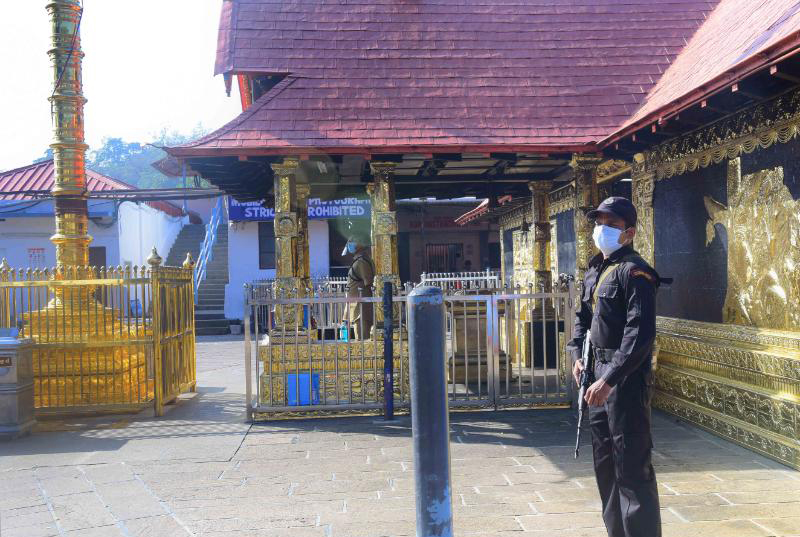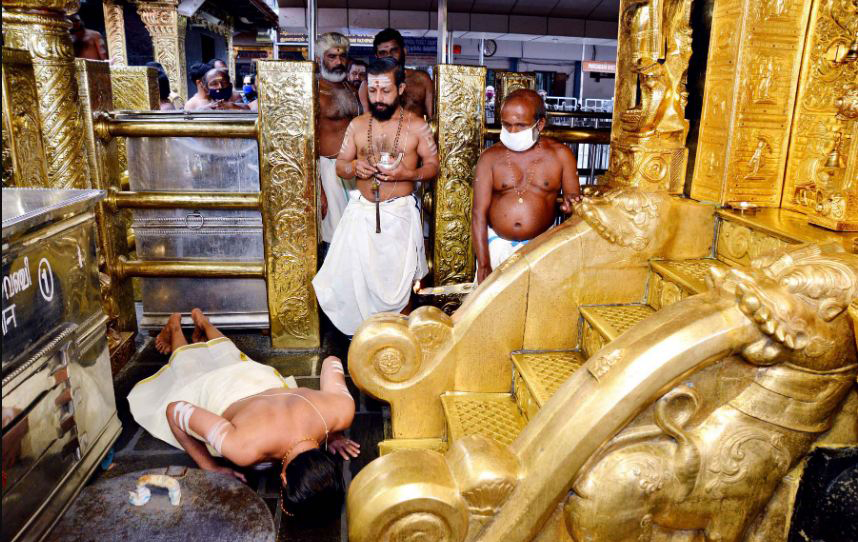
The Sabarimala Temple (Malayalam pronunciation: is a temple complex located at Sabarimala hill inside the Periyar Tiger Reserve in the Perinad Village, Pathanamthitta district, Kerala, India. It is one of the largest annual pilgrimage sites in the world with an estimate of over 40 to 50 million devotees visiting every year.
The temple is dedicated to a Hindu Brahmachari (Celibate) deity Ayyappan also known as Dharma Shasta, who according to belief is the son of Shiva and Mohini, the feminine incarnation of Vishnu.The traditions of Sabarimala are a confluence of Shaivism, Vaishnavism, and other Śramaṇa traditions.
The temple is situated on a hilltop amidst eighteen hills at an altitude of 1260 m (4,134 ft) above sea level, and is surrounded by mountains and dense forests. The dense forest, part of the Periyar Tiger Reserve, around the temple is known as Poongavanam. Temples exist in each of the hills surrounding Sabarimala. While functional and intact temples exist at many places in the surrounding areas like Nilakkal, Kalaketty, and Karimala, remnants of old temples survive to this day on remaining hills.
The pilgrimage includes a unique tradition, that of offering prayer at a mosque of Vavar, a Muslim devotee of Ayappan.
Ayyappan also called Dharmasastha and Manikandan, is a Hindu deity popular in Southern India, particularly in the states of Kerala, Tamil Nadu and Karnataka. He is considered to be the epitome of dharma, truth, and righteousness and is often called upon to obliterate evil.
Although devotion to Ayyappan has been prevalent earlier in South India, his popularity rose only in the late 20th century. According to Hindu theology, he is the son of Harihara (Vishnu in the form of Mohini and Shiva). Ayyappan is also referred to as Ayyappa, Sastavu, Hariharasudhan, Manikandan, Shasta or Dharma Shasta and Sabarinath.
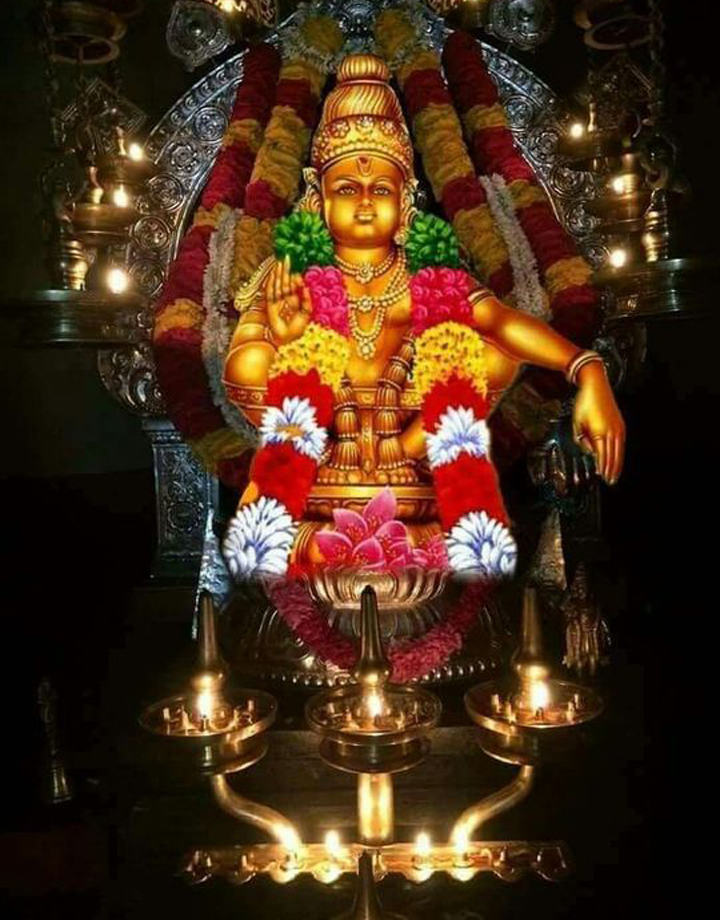
The iconography of Ayyappan depicts him as a handsome celibate (Brahmachari) deity doing yoga and as an epitome of Dharma, who wears a bell around his neck. He is also honoured by Muslims in Kerala, with legends wherein Ayyappan defeats and gains worship of the Muslim brigand Vavar.
In the Hindu tradition popular in the Western Ghats of India, he was born with the powers of Shiva and Vishnu to confront and defeat the shape-shifting evil Buffalo demoness Mahishi. He was raised by a childless royal couple Rajashekara pandiyan and Koperundevi, and grows up as a warrior yogi champion of ethical and dharmic living.In South Indian portrayals, Ayyappan images show him riding a tigress, but in some places such as Sri Lanka he is shown as riding a white elephant.
Ayyappan's popularity has grown in many parts of India, and the most prominent Ayyappan shrine is at Sabarimala, nestled in the hills of Pathanamthitta of Kerala. The shrine receives millions of pilgrims every year in late December and early January, many of whom prepare for weeks before and then climb the hill barefoot, making it one of the largest active pilgrimage sites in the world.
The pilgrimage attracts a wide range of devotees, from diverse social or economic backgrounds, except women in their fertile age because Ayyappan is believed to be the celibate deity. He remains one of the few deities in Hindu tradition, who is respected by other religious communities, including Muslims and Christians in Kerala.
The most significant festival linked to him is the Makaravilakku (Makara Sankranti), observed around the winter solstice.
The name Ayyappan (sometimes spelled as Ayyappa or Aiyappan) may be related to as "Lord Father". The name may literally come from "Ayyan" and "Appan" both meaning "Father".
The root names "Ayyan" and "Appan" denotes Mohini (Mohini here called father, she is a female form of the god Vishnu) and Shiva respectively.
However, the word Ayyappan is not found in South Indian versions of the medieval era Puranas, leading scholars to the hypothesis that Ayyappan may have roots elsewhere. The alternate theory links it to the Malayali word acchan and Tamil word appa which means "father", with Ayyappan connoting "Lord-father".
The alternate proposal is supported by the alternate name for Ayyappan being Sastava (Sasta, Sashta, Sastra), a Vedic term that also means "Teacher, Guide, Lord, Ruler". The words Sastha and Dharmasastha in the sense of a Hindu god are found in the Puranas.
Ayyappan is also known as Hariharasudhan– meaning the "son of Harihara" or a fusion deity of Hari and Hara, the names given to Vishnu and Shiva respectively.
He is also called Manikanta from Mani, Sanskrit for precious stone,and kanta, Sanskrit for neck. In some regions, Ayyappa and Ayyanar are considered to be the same deity given their similar origin. Others consider him as different because their worship methods are not the same.
Ayyappan is a warrior deity. He is revered for his ascetic devotion to Dharma – the ethical and right way of living, to deploy his military genius and daring yogic war abilities to destroy those who are powerful but unethical, abusive and arbitrary.
His iconography is usually shown with a bow and arrow upraised in his left hand, while in his right he holds either a bow or a sword diagonally across his left thigh. Other depictions of Ayyappan, particularly paintings, generally show him in a yogic posture wearing a bell around his neck and sometimes shown riding a tiger.
The legends and mythology of Ayyappa varies across region like other Hindu gods and goddesses, reflecting a tradition that evolved and enriched over time, sometimes in conflicting ways. For example, the Sribhutanatha Purana text presents Ayyappan as an incarnation of the Hindu deity Hariharaputra, the son of Shiva and Mohini.
Meera Subramanian says,
The temple architecture and spiritual energy are amazing. Felt deeply connected.
Lakshmi Narayan says,
Every visit brings inner peace and strength. Jai Shri Ram ????
Suresh Kumar says,
The divine presence here is very powerful. A truly holy Swayambhu temple
Kavya Nair says,
Such a serene and spiritually uplifting temple. Felt calm and blessed.
Arjun Patel says,
A sacred place filled with devotion and history. Highly recommend visiting with family
Ananya Reddy says,
Blessed to have darshan here. The vibrations and positivity are beyond words.
Priya Iyer says,
An unforgettable spiritual experience. The atmosphere is so pure and peaceful.
Rahul Sharma says,
Felt divine energy as soon as I entered the temple. Truly a powerful Swayambhu kshetra. ????
Time (IST). Morning. Opening of sanctum sanctorum, Nirmalyam Abhishekam. 3:00 AM. Ganapati Homam. 3:30 AM. Neyyabhishekam. From 3:30 to 7:00 AM. Usha Pooja.
Opening of sanctum sanctorum: 3:00 PM
Usha Pooja: From 7:30 AM
Closing of sanctum sanctorum: 1:00 PM
Deeparadhana: 6:30 PM
Sannidhanam, Sabarimala, Kerala 689662
General Enquiry : 70
Explore spiritual insights, reviews, and divine writings shared by our esteemed Priests & Guides.
Sri Ramananda shares the importance of morning poojas for spiritual awakening.
Guru Venkatesh explains how daily mantra chanting transforms mental and spiritual well-being.
The temple is dedicated to a Hindu Brahmachari (Celibate) deity Ayyappan also known as Dharma Shasta, who according to belief is the son of Shiva and Mohini, the feminine incarnation of Vishnu. The traditions of Sabarimala are a confluence of Shaivism, Vaishnavism, and other Śramaṇa traditions.
The Sabarimala Temple (Malayalam pronunciation: is a temple complex located at Sabarimala hill inside the Periyar Tiger Reserve in the Perinad Village, Pathanamthitta district, Kerala, India. It is one of the largest annual pilgrimage sites in the world with an estimate of over 40 to 50 million devotees visiting every year.
The temple is dedicated to a Hindu Brahmachari (Celibate) deity Ayyappan also known as Dharma Shasta, who according to belief is the son of Shiva and Mohini, the feminine incarnation of Vishnu.The traditions of Sabarimala are a confluence of Shaivism, Vaishnavism, and other Śramaṇa traditions.
The temple is situated on a hilltop amidst eighteen hills at an altitude of 1260 m (4,134 ft) above sea level, and is surrounded by mountains and dense forests. The dense forest, part of the Periyar Tiger Reserve, around the temple is known as Poongavanam. Temples exist in each of the hills surrounding Sabarimala. While functional and intact temples exist at many places in the surrounding areas like Nilakkal, Kalaketty, and Karimala, remnants of old temples survive to this day on remaining hills.
The pilgrimage includes a unique tradition, that of offering prayer at a mosque of Vavar, a Muslim devotee of Ayappan.
Information not available.
Ayyappan also called Dharmasastha and Manikandan, is a Hindu deity popular in Southern India, particularly in the states of Kerala, Tamil Nadu and Karnataka. He is considered to be the epitome of dharma, truth, and righteousness and is often called upon to obliterate evil.
Although devotion to Ayyappan has been prevalent earlier in South India, his popularity rose only in the late 20th century. According to Hindu theology, he is the son of Harihara (Vishnu in the form of Mohini and Shiva). Ayyappan is also referred to as Ayyappa, Sastavu, Hariharasudhan, Manikandan, Shasta or Dharma Shasta and Sabarinath.
The iconography of Ayyappan depicts him as a handsome celibate (Brahmachari) deity doing yoga and as an epitome of Dharma, who wears a bell around his neck. He is also honoured by Muslims in Kerala, with legends wherein Ayyappan defeats and gains worship of the Muslim brigand Vavar.
In the Hindu tradition popular in the Western Ghats of India, he was born with the powers of Shiva and Vishnu to confront and defeat the shape-shifting evil Buffalo demoness Mahishi. He was raised by a childless royal couple Rajashekara pandiyan and Koperundevi, and grows up as a warrior yogi champion of ethical and dharmic living.In South Indian portrayals, Ayyappan images show him riding a tigress, but in some places such as Sri Lanka he is shown as riding a white elephant.
Ayyappan's popularity has grown in many parts of India, and the most prominent Ayyappan shrine is at Sabarimala, nestled in the hills of Pathanamthitta of Kerala. The shrine receives millions of pilgrims every year in late December and early January, many of whom prepare for weeks before and then climb the hill barefoot, making it one of the largest active pilgrimage sites in the world.
The pilgrimage attracts a wide range of devotees, from diverse social or economic backgrounds, except women in their fertile age because Ayyappan is believed to be the celibate deity. He remains one of the few deities in Hindu tradition, who is respected by other religious communities, including Muslims and Christians in Kerala.
The most significant festival linked to him is the Makaravilakku (Makara Sankranti), observed around the winter solstice.
The name Ayyappan (sometimes spelled as Ayyappa or Aiyappan) may be related to as "Lord Father". The name may literally come from "Ayyan" and "Appan" both meaning "Father".
The root names "Ayyan" and "Appan" denotes Mohini (Mohini here called father, she is a female form of the god Vishnu) and Shiva respectively.
However, the word Ayyappan is not found in South Indian versions of the medieval era Puranas, leading scholars to the hypothesis that Ayyappan may have roots elsewhere. The alternate theory links it to the Malayali word acchan and Tamil word appa which means "father", with Ayyappan connoting "Lord-father".
The alternate proposal is supported by the alternate name for Ayyappan being Sastava (Sasta, Sashta, Sastra), a Vedic term that also means "Teacher, Guide, Lord, Ruler". The words Sastha and Dharmasastha in the sense of a Hindu god are found in the Puranas.
Ayyappan is also known as Hariharasudhan– meaning the "son of Harihara" or a fusion deity of Hari and Hara, the names given to Vishnu and Shiva respectively.
He is also called Manikanta from Mani, Sanskrit for precious stone,and kanta, Sanskrit for neck. In some regions, Ayyappa and Ayyanar are considered to be the same deity given their similar origin. Others consider him as different because their worship methods are not the same.
Ayyappan is a warrior deity. He is revered for his ascetic devotion to Dharma – the ethical and right way of living, to deploy his military genius and daring yogic war abilities to destroy those who are powerful but unethical, abusive and arbitrary.
His iconography is usually shown with a bow and arrow upraised in his left hand, while in his right he holds either a bow or a sword diagonally across his left thigh. Other depictions of Ayyappan, particularly paintings, generally show him in a yogic posture wearing a bell around his neck and sometimes shown riding a tiger.
The legends and mythology of Ayyappa varies across region like other Hindu gods and goddesses, reflecting a tradition that evolved and enriched over time, sometimes in conflicting ways. For example, the Sribhutanatha Purana text presents Ayyappan as an incarnation of the Hindu deity Hariharaputra, the son of Shiva and Mohini.
The temple is dedicated to a Hindu Brahmachari (Celibate) deity Ayyappan also known as Dharma Shasta, who according to belief is the son of Shiva and Mohini, the feminine incarnation of Vishnu. The traditions of Sabarimala are a confluence of Shaivism, Vaishnavism, and other Śramaṇa traditions.
Information not available.
Time (IST). Morning. Opening of sanctum sanctorum, Nirmalyam Abhishekam. 3:00 AM. Ganapati Homam. 3:30 AM. Neyyabhishekam. From 3:30 to 7:00 AM. Usha Pooja.
Opening of sanctum sanctorum: 3:00 PM
Usha Pooja: From 7:30 AM
Closing of sanctum sanctorum: 1:00 PM
Deeparadhana: 6:30 PM
Sannidhanam, Sabarimala, Kerala 689662
General Enquiry : 70, 41656, KL, IN


Leave a Comment